• Google Will Help Protect Your Computer from Malware


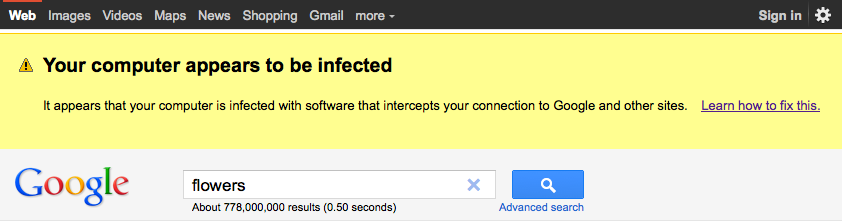
    Google has been able to detect a large number of computers infected with a specific piece of malware. If you go to Google and do a search (any word will do) right now, check to see whether you get a “Your computer appears to be infected” warning at the top of the search results. If you see the message, you need to clean up the infection from your machine.

    As we work to protect our users and their information, we sometimes discover unusual patterns of activity. Recently, we found some unusual search traffic while performing routine maintenance on one of our data centers. After collaborating with security engineers at several companies that were sending this modified traffic, we determined that the computers exhibiting this behavior were infected with a particular strain of malicious software, or “malware.” As a result of this discovery, today some people will see a prominent notification at the top of their Google web search results:

    This particular malware causes infected computers to send traffic to Google through a small number of intermediary servers called “proxies.” We hope that by taking steps to notify users whose traffic is coming through these proxies, we can help them update their antivirus software and remove the infections.

    You can run a system scan on your computer yourself by following the steps mentioned here. This is malware that’s specific to Windows.
  • Apple May Show Interest in WiTricity Wireless Charging


    Last week, the WSJ reported that Apple was experimenting with “a new way of charging” the 2012 iPhone. Of course, wireless charging isn’t a new technology though the current implementations of it have been somewhat limited.

    The original Palm Pre launched with an induction charger which allows users to charge their device when it is laid on a special charging mat. The disadvantages of such inductive chargers is the need for near physical contact in order for the power to be transferred as well as heat/power limitations.

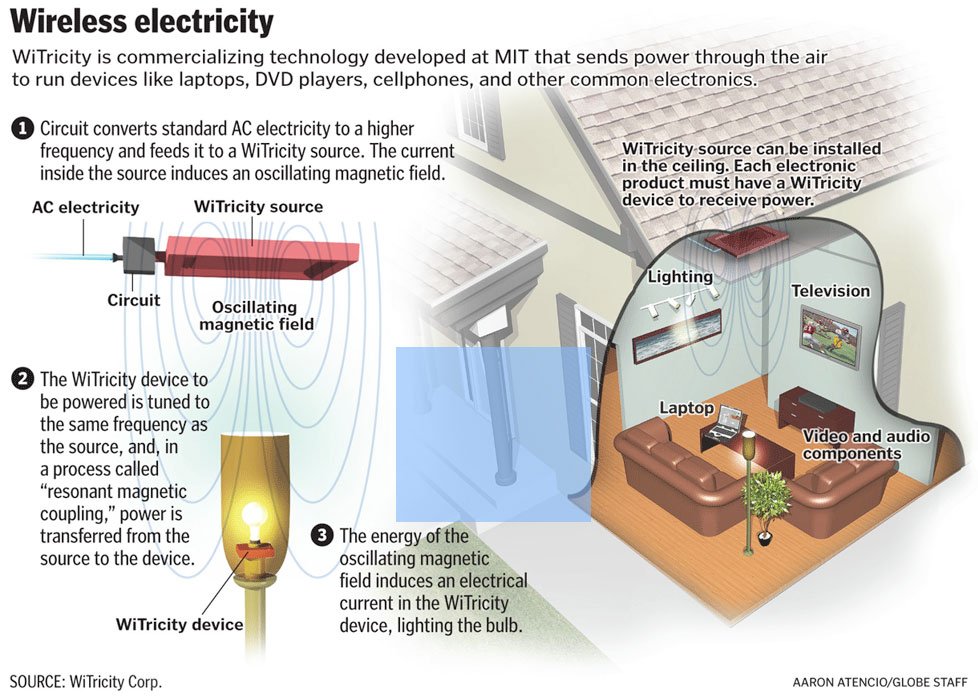
    A 2007 startup company called WiTricity, however, has been working on some significant advances in wireless electricity that has gotten the attention of much of the industry including Apple. WiTricity is based on the research from MIT’s labs where scientists showed a new method for transferring larger amounts of power wirelessly over more practical distances (up to a couple of meters) than traditional induction.

    The magnetic fields of two properly designed devices with closely matched resonant frequencies can couple into a single continuous magnetic field. Prof. Soljačić’s team showed how to use this phenomenon to enable the transfer of power from one device to the other at high efficiency and over a distance range that is useful for real-world applications.

    WiTricity has already received a significant amount of industry attention. The CEO of WiTricity demoed the technology at TED in 2009. Intel has been experimenting with the technology in their labs. Toyota has even collaborated with and invested in the company to develop automotive wireless charging systems.

    The link to Apple comes by way of a international patent application from Apple called “Wireless power utilization in a local computing environment.” The application was first published in May of this year and specifically details the same resonance technology and refers to the original paper published by the MIT researchers.

    Apple describes a scenario where your iMac could be the source of this resonance power to provide a virtual charging area in front of your computer. Keyboards, mice and even mobile electronic devices like the iPhone or iPad could be charged simply be being in a 1 meter proximity to your computer. In typical Apple fashion, they describe that “by doing away with clumsy and annoying cables and eliminating the need to replace batteries, an easy to use and efficient local computing environment can be provided to the user.”

    The technology is said to be safe, relying on magnetic fields. WiTricity CEO is seen below presenting the technology at the 2009 TED and even shows it wirelessly powering a modified Apple iPhone.

    [via macrumors]

  • Apple’s iCloud is Powered by Windows Azure and Amazon S3 Services


    It looks like Apple has turned to Microsoft and Amazon for help in the cloud services. The hints of this came from an anonymous source who sent a set of screen shots to InfiniteApple. The screenshots supposedly show Apple’s new iMessage service in action – specifically, the HTTP traffic log. The images seem to indicate that iCloud is getting some assistance from S3, Amazon’s cloud storage system, and Azure, Microsoft’s cloud service.

    PUT https://mssat000001.blob.core.windows.net:443/cnt/1234.5678 HTTP/1.1
    Host: mssat000001.blob.core.windows.net:443

    HTTP/1.1 201 Created
    Content-MD5: [redacted]
    Last-Modified: [redacted]
    ETag: [redacted]
    Server: Windows-Azure-Blob/1.0 Microsoft-HTTPAPI/2.0
    x-ms-request-id: [redacted]
    x-ms-version: 2009-09-19
    Date: [redacted]
    Connection: close
    Content-Length: 0

    Exactly how the Microsoft Azure and Amazon S3 cloud systems may be helping Apple’s iCloud is unclear, but whats there is that both companies involvements is merely related to iCloud’s back-end and it’s unlikely they had major involvement in developing iCloud per se.

  • Google Wallet Announced, Your Phone is Your Wallet


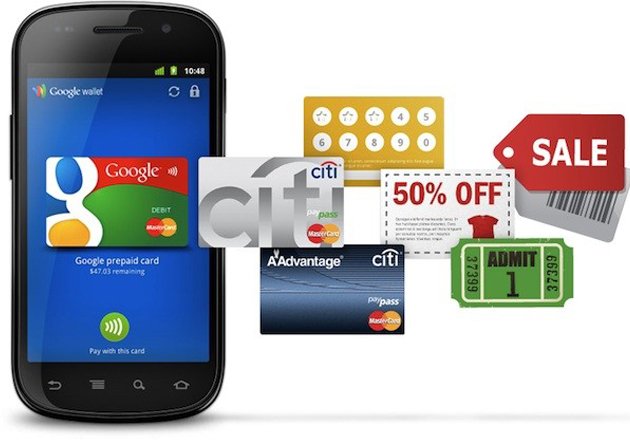
    At an event today, Google, Citi, MasterCard, First Data and Sprint announced and demonstrated Google Wallet, an app that will make your phone your wallet so you can tap, pay and save money and time while you shop.

    Today, we’ve joined with leaders in the industry to build the next generation of mobile commerce,” said Stephanie Tilenius, vice president, commerce and payments, Google. “With Citi, MasterCard, First Data and Sprint we’re building an open commerce ecosystem that for the first time will make it possible for you to pay with an NFC wallet and redeem consumer promotions all in one tap, while shopping offline.

    At launch, Google Wallet will support payments with two payment solutions: a PayPass eligible Citi MasterCard and a virtual Google Prepaid card. Most people who already have a PayPass eligible Citi MasterCard can simply add it to Google Wallet over the air, using First Data’s trusted service manager service. Or, they can fund the Google Prepaid card with any payment card.

    Google Wallet uses near field communication (NFC) to make secure payments fast and convenient by simply tapping the phone on any PayPass-enabled terminal at checkout.

    MasterCard has pioneered mobile payments with our PayPass technology and we’re proud that it is at the heart of Google Wallet,” said Ed McLaughlin, chief emerging payments officer, MasterCard. “We’re excited to partner with these industry leaders today and committed to continuing to play a leadership role in the development of mobile payment technologies.

    Google Wallet is currently in a field test and will be available to consumers this summer. The first release of Google Wallet is expected to be released on the Nexus S 4G on the Sprint network. Additional devices with NFC capabilities will follow.