People have been wondering what should Apple do with its enormous pile of cash. If TechCrunch is to be believed, a new report suggests that Apple is about to spend between $400 and $500 million to acquire Anobit, an Israeli-based flash memory chip maker.
If this is a true, it would be the 5th Hardware company acquired since the first Steve Jobs founded NeXT, Raycer Graphics, Intrinsity and P.A. Semi.
Anobit provides flash storage solutions for enterprise and mobile markets, based on its proprietary MSP (which stands for ‘Memory Signal Processing’) technology. Its solutions are designed to improve the speed, endurance and performance of flash storage systems while driving down the cost.
According to Calcalistreport, Apple relies on the company’s solutions for the iPhone, iPad and MacBook Air product lines, among other devices. South Korean Hynix is said to use Anobit’s solution for a flash memory chip you can find inside the iPhone 4S.
Apple is likely interested in the 200-people company to add them to its base of engineering talents.
Last week, the WSJreported that Apple was experimenting with “a new way of charging” the 2012 iPhone. Of course, wireless charging isn’t a new technology though the current implementations of it have been somewhat limited.
The original Palm Pre launched with an induction charger which allows users to charge their device when it is laid on a special charging mat. The disadvantages of such inductive chargers is the need for near physical contact in order for the power to be transferred as well as heat/power limitations.
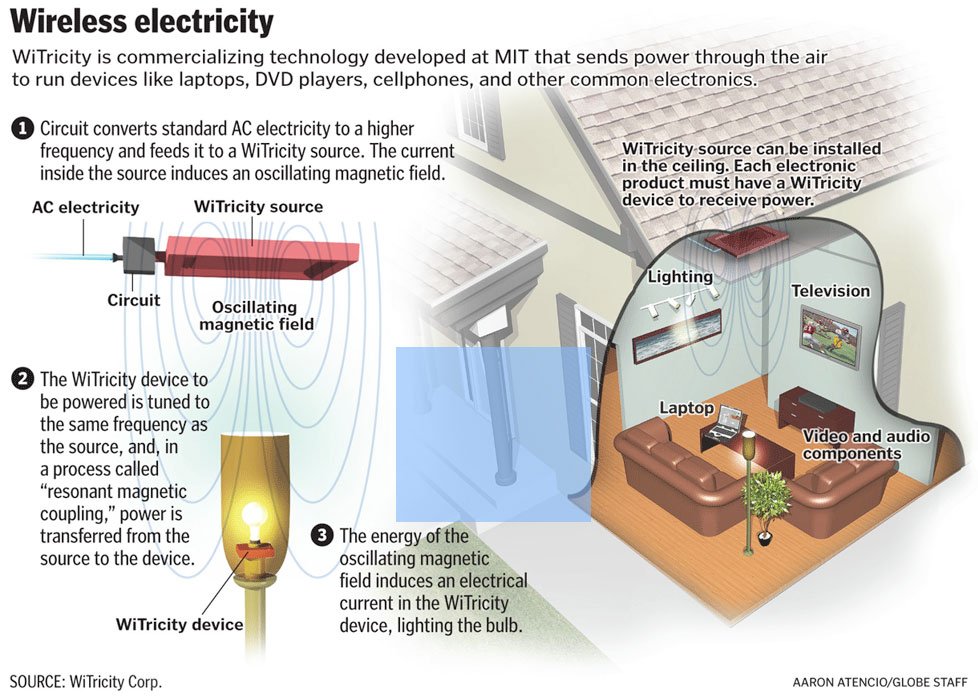
A 2007 startup company called WiTricity, however, has been working on some significant advances in wireless electricity that has gotten the attention of much of the industry including Apple. WiTricity is based on the research from MIT’s labs where scientists showed a new method for transferring larger amounts of power wirelessly over more practical distances (up to a couple of meters) than traditional induction.
The magnetic fields of two properly designed devices with closely matched resonant frequencies can couple into a single continuous magnetic field. Prof. SoljaÄić’s team showed how to use this phenomenon to enable the transfer of power from one device to the other at high efficiency and over a distance range that is useful for real-world applications.
WiTricity has already received a significant amount of industry attention. The CEO of WiTricity demoed the technology at TED in 2009. Intel has been experimenting with the technology in their labs. Toyota has even collaborated with and invested in the company to develop automotive wireless charging systems.
The link to Apple comes by way of a international patent application from Apple called “Wireless power utilization in a local computing environment.” The application was first published in May of this year and specifically details the same resonance technology and refers to the original paper published by the MIT researchers.
Apple describes a scenario where your iMac could be the source of this resonance power to provide a virtual charging area in front of your computer. Keyboards, mice and even mobile electronic devices like the iPhone or iPad could be charged simply be being in a 1 meter proximity to your computer. In typical Apple fashion, they describe that “by doing away with clumsy and annoying cables and eliminating the need to replace batteries, an easy to use and efficient local computing environment can be provided to the user.”
The technology is said to be safe, relying on magnetic fields. WiTricity CEO is seen below presenting the technology at the 2009 TED and even shows it wirelessly powering a modified Apple iPhone.
DigiTimes is reporting that the supply chain for not only the iPhone 5 but iPad 3 is beginning to prepare materials for production of the two devices. Both devices are likely to make their debuts in September and to hit the market in October, according to industry sources.
iPhone 5’s supply volume is estimated to be around 6-7 million units in the third quarter and with the addition of iPhone 4 shipments, total iPhone shipments in the quarter will reach 24-25 million units with volumes to maintain at the same level in the fourth quarter. In 2011, Apple is forecasted to ship over 85 million iPhones.
Upstream component makers including Foxconn Electronics (Hon Hai Precision Industry), which is in charge of assembling the devices; Simplo Technologies and Dynapack International Technology, in charge of manufacturing batteries; TPK Holding and Wintek, in charge of touch panel modules; Catcher, in charge of chassis; and Largan Precision, in charge of webcams, are all expected to benefit from the orders.
DigiTimes has somewhat of a hit-and-miss record of Apple related rumors, while the iPhone 5 is expected, the iPad 3 release is somehow questionable. Previous rumors pointed out to two iPad will make their releases this year, so this might work this time.
The LATimesreports that iCloud will initially be offered free but eventually costing users $25/year subscription:
Dubbed iCloud, the service initially will be offered for a free period to people who buy music from Apple’s iTunes digital download store, allowing users to upload their music to Apple’s computers where they can then play from a Web browser or Internet-connected Apple device.
The company plans to eventually charge a subscription fee, about $25 a year, for the service. Apple would also sell advertising around its iCloud service.
We reported eariler that Apple has reached agreements with the four major record labels for their upcoming cloud service.
The agreements, finalized this week, call for Apple to share 30% of any revenue from iCloud’s music service with record labels, as well as 12% with music publishers holding the songwriting rights. Apple is expected to keep the remaining 58%, said people knowledgeable with the terms.
Are you looking forward to iCloud with $25 a year subscription?