• Microsoft is Square, Apple is Roundrect, Nokia is Squircle, Google is…?


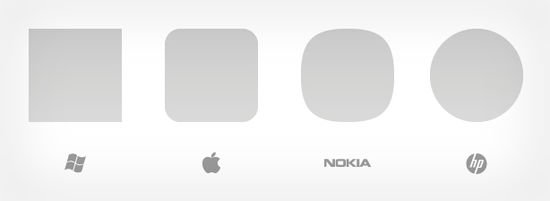
    Clayton Miller’s Interuserface takes a look at the iconic shapes behind today’s biggest mobile companies, and while Apple, iPhone, and iPad are obviously roundrects (rounded rectangles), their competition is just as geometrically aligned:

    Microsoft’s Metro UI owns the square. Apple has a corner on the roundrect, from the Springboard launcher to the iPhone hardware itself. Nokia, despite its late entry with MeeGo’s Harmattan UI, found the squircle unclaimed and ran with it beautifully. Palm has used the circle from the early days of PalmOS, and in WebOS, HP continues the tradition with care (one might even note that both Palm and HP structure their wordmarks around the circle).

    The power of shapes:

    Like color, which also despite limitless associations has a history of strong associations within a market, shape is a powerful, yet subtle differentiator. Owning a shape isn’t easy – by itself, as demonstrated by Samsung and RIM, a shape is hardly potent. Those who have successfully laid claim to a shape have used it as a building block rather than as window dressing. Use the power of shape to reinforce good design with coherence and identity – and that shape may one day be yours.

    Zune, obviously, couldn’t hold the squircle, and neither Bada nor RIM could take the square or roundrect as their own. Interestingly, Google’s Android has no iconic hold on any simple shape (nor do Facebook or Amazon for that matter, who have elected to stick with letters).

  • BlackBerry Messenger Coming to iPhone on April 26


    RIM was looking for a way to expand its BlackBerry Messenger platform to iOS and Android devices, with a release coming soon in the App Store. RIM apparently wasn’t happy about the hundreds of apps clearly inspired by BBM available for iPhones and iPads, and decided to develop a version of Messenger that doesn’t have all the features available to BlackBerry owners, but still allows iOS users to communicate with their friends and family. A compromise, that is, to have BlackBerry Messenger available on as many platforms as possible.

    A poster on MacRumors Forums now suggests BlackBerry Messenger for iOS may be launching in the App Store on April 26. At a “social media conference” in Toronto, RIM’s co-CEO Jim Balsillie allegedly revealed that BBM and “other services” will come to the iPhone on April 26 through the App Store. Balsillie also confirmed that they plan to release an update “this summer” with a new notification system, which may or may not suggest RIM knows something about iOS 5 and the improved notifications Apple has been rumored to be working on. But, then again, it is unclear why would RIM know about such an important aspect of iOS and Balsillie’s statements might just be speculation on his side.

    Right now, we have heard that Android is definitely a go. But again, we’re not sure on timing, though our sources are confident that it will launch some time this year. RIM chose Android first because of the fact that it could develop and integrate something like this much easier with an open platform, but the plan is to build and deploy an iOS version at some point as well.

    So it is possible that in the next few days an Android version of BBM will be unveiled, with the iPhone app scheduled for a late April launch. The rumor hasn’t been confirmed by RIM, but chances are they are really looking for a way to rise among the competition in the App Store (made of apps like WhatsApp, Textie and Ping) by releasing an iOS counterpart of BBM, which counts millions of users worldwide.

  • RIM To Bring BlackBerry Messaging To The App Store


    Research In Motion is preparing to bring Blackberry Messenger to iOS through the App Store.

    RIM wants to own the messaging space, and that means being ubiquitous across all platforms. It’s a curious move: BlackBerry Messaging is one of the few reasons people still buy BlackBerry smartphones over an iOS or Android device.

    Ceding the messaging advantage to the competition? A curious move to say the least, especially since RIM is supposedly hopeful that their new BlackBerry tablet, the PlayBook, can help them get back some of their sales mojo. Does RIM see its future as being primarily in software over hardware? Are they already ceding victory to Apple and Google?

    [via: TUAW]

  • Kodak fails in case against Apple


    Eastman Kodak Company has lost a critical part of its ITC case against Apple and RIM, in which the company which claims invention of the first ever digital camera back in 1975 has been trying to win royalty payments on a common image-preview feature used in phones.

    U.S. International Trade Commission Judge Paul Luckern said Apple’s iPhone and RIM’s BlackBerry don’t violate Kodak’s patent. These findings are subject to a six person review board for final approval, but it isn’t looking so great for Kodak right now.

    Kodak is trying to raise royalties from its pool of over 1,000 digital-imaging patents as it attempts to finance new modern digital photography product development.

    In response, Apple has filed its own patent-infringement complaint at the ITC against Kodak, trial begins Jan. 31.