• Twitter to Roll Out Ads and Promoted Tweets in User Timelines


    Its final, Twitter would soon begin to roll out ads, Promoted Tweets, in user timelines. The truth is that they’ve been talking about this possibility for a while. And they’ve even tested it with third party partners like Hootsuite. According to MG Siegler. Twitter will start placing them on Twitter.com.

    The sponsored Tweets will only appear in your timeline if you already follow the account that has paid for the spot. If that’s the case, a single Promoted Tweet will appear at (or near) the top of your main timeline when you log in to twitter.com for the first time in any given day. As you get new Tweets, these Promoted Tweets will be pushed down just like regular Tweets. But if you refresh the page, the ad will appear at the top of the timeline again, is our understanding.

    These ads will also be clearly marked as “Promoted” with an orange arrow icon below the tweet, the same way Promoted Tweets and Trends are currently shown on the sidebar or in search. And it will say the full company name of the company that is doing the promotion. These Tweets can also be dismissed from your timeline with one click. More from twitter blog:

    That’s why starting today, we’re introducing a way to ensure that the most important Tweets from the organizations you follow reach you directly, by placing them at or near the top of your timeline. These Promoted Tweets will scroll through the timeline like any other Tweet, and like regular Tweets, they will appear in your timeline just once. Promoted Tweets can also be easily dismissed from your timeline with a single click.

  • 800 out of 10,000 Android Apps Leak Private Information


    Android has had its fair share of malware problems. Whenever malware are detected, Google reacts swiftly and remove them. However, according to a report from Digitizor, security researcher Neil Daswani, around 8% of the apps on the Android market are leaking private user data.

    Neil Daswani, who is also the CTO of security firm Dasient, says that they have studied around 10,000 Android apps and have found that 800 of them are leaking private information of the user to an unauthorized server. Neil Daswani is scheduled to present the full findings at the Black Hat Conference in Las Vegas which starts on July 30th.

    This malware problem on Android has become too much. One of the main reason that we see malicious apps in the market is because of the lack of regulation in the apps that get into the Android Market.

    Sure, the lack of regulation can be good. It means that developers can make their apps without worrying if Google will accept their apps or not. It fits into the pre-existing application distribution model where anyone can develop and publish their own apps.

    I think that it is time that Google make approval of the apps a requirement before it gets into the Market. They do not need to do it like Apple, but a basic security check before an app gets on the market will be nice.

  • Apple Begins Test Production Of A6 Processor with TSMC


    Citing a source with knowledge of the matter, Apple and Taiwan-based TSMC have begun manufacturing test of Apple’s next-generation A6 processor. The fact that Apple is working with TSMC on this may serve as a sign that Apple is shifting from its traditional chip supplier, Samsung Electronics.

    Currently, Samsung is the sole supplier of the A5 chips used in the iPad 2, but Apple has hinted it is keen to diversify away from the Korean company. The two are battling a legal dispute over patents, and Samsung has also emerged as Apple’s toughest competitor in the smartphone and tablet market.

    It’s currently not finalized that TSMC will produce the new chip for Apple. but the test run is said to be authorized. It’s also expected that Samsung will lower prices and fight to retain Apple’s business in manufacturing the A6.

    “It has to redesign the chipset, which Samsung has been deeply involved from the beginning and has some intellectual property. Apple could try various suppliers but they (Samsung and Apple) need each other and the relationship will continue.”

    The A5 chip is designed by the California company and analysts say it is based on British chip designer ARM Holdings technology. Details of Apple’s technology are hard to come by though given its obsession with secrecy.

    The A6 will likely debut next year as part of 3rd generation iPad, as the current trend is for Apple to place new technology in the iPad first, then shrink and optimize it later for use in the iPhone.

    The A6 will reportedly use a new 28-nanometer process, making it smaller and more power efficient, and could be powerful enough to use inside future Macs, such as future models of the MacBook Air which is a strong possibility.

  • Apple May Show Interest in WiTricity Wireless Charging


    Last week, the WSJ reported that Apple was experimenting with “a new way of charging” the 2012 iPhone. Of course, wireless charging isn’t a new technology though the current implementations of it have been somewhat limited.

    The original Palm Pre launched with an induction charger which allows users to charge their device when it is laid on a special charging mat. The disadvantages of such inductive chargers is the need for near physical contact in order for the power to be transferred as well as heat/power limitations.

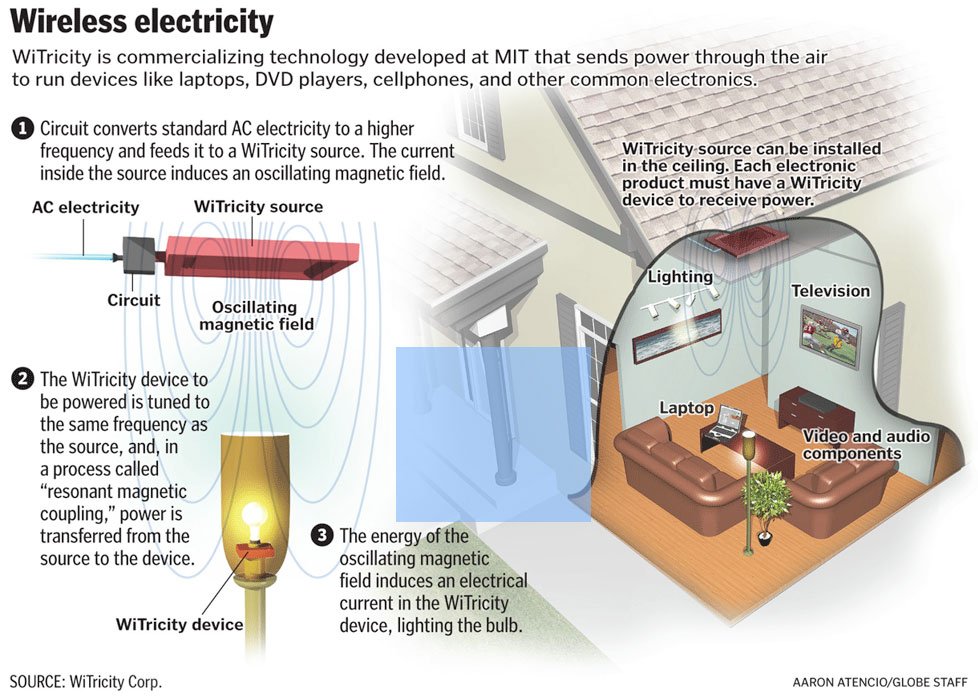
    A 2007 startup company called WiTricity, however, has been working on some significant advances in wireless electricity that has gotten the attention of much of the industry including Apple. WiTricity is based on the research from MIT’s labs where scientists showed a new method for transferring larger amounts of power wirelessly over more practical distances (up to a couple of meters) than traditional induction.

    The magnetic fields of two properly designed devices with closely matched resonant frequencies can couple into a single continuous magnetic field. Prof. Soljačić’s team showed how to use this phenomenon to enable the transfer of power from one device to the other at high efficiency and over a distance range that is useful for real-world applications.

    WiTricity has already received a significant amount of industry attention. The CEO of WiTricity demoed the technology at TED in 2009. Intel has been experimenting with the technology in their labs. Toyota has even collaborated with and invested in the company to develop automotive wireless charging systems.

    The link to Apple comes by way of a international patent application from Apple called “Wireless power utilization in a local computing environment.” The application was first published in May of this year and specifically details the same resonance technology and refers to the original paper published by the MIT researchers.

    Apple describes a scenario where your iMac could be the source of this resonance power to provide a virtual charging area in front of your computer. Keyboards, mice and even mobile electronic devices like the iPhone or iPad could be charged simply be being in a 1 meter proximity to your computer. In typical Apple fashion, they describe that “by doing away with clumsy and annoying cables and eliminating the need to replace batteries, an easy to use and efficient local computing environment can be provided to the user.”

    The technology is said to be safe, relying on magnetic fields. WiTricity CEO is seen below presenting the technology at the 2009 TED and even shows it wirelessly powering a modified Apple iPhone.

    [via macrumors]