Microsoft has released a new Forza Motorsport 4 trailer, or rather it’s an old, but previously unreleased video first shown at its E3 media briefing last month.
The new installment of the Turn 10 racer is set to include Kinect support, content from Beeb car show Top Gear and a more detailed Career Mode. Watch the trailer below:
Forza 4’s out on October 11, in Europe October 14.
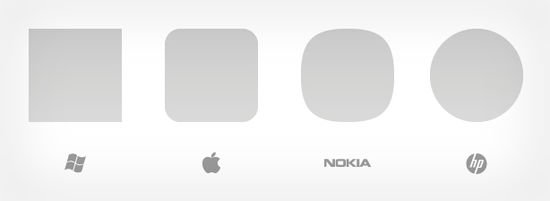
Clayton Miller’s Interuserfacetakes a look at the iconic shapes behind today’s biggest mobile companies, and while Apple, iPhone, and iPad are obviously roundrects (rounded rectangles), their competition is just as geometrically aligned:
Microsoft’s Metro UI owns the square. Apple has a corner on the roundrect, from the Springboard launcher to the iPhone hardware itself. Nokia, despite its late entry with MeeGo’s Harmattan UI, found the squircle unclaimed and ran with it beautifully. Palm has used the circle from the early days of PalmOS, and in WebOS, HP continues the tradition with care (one might even note that both Palm and HP structure their wordmarks around the circle).
The power of shapes:
Like color, which also despite limitless associations has a history of strong associations within a market, shape is a powerful, yet subtle differentiator. Owning a shape isn’t easy – by itself, as demonstrated by Samsung and RIM, a shape is hardly potent. Those who have successfully laid claim to a shape have used it as a building block rather than as window dressing. Use the power of shape to reinforce good design with coherence and identity – and that shape may one day be yours.
Zune, obviously, couldn’t hold the squircle, and neither Bada nor RIM could take the square or roundrect as their own. Interestingly, Google’s Android has no iconic hold on any simple shape (nor do Facebook or Amazon for that matter, who have elected to stick with letters).
Microsoft recently launched a mobile IE9 testing site that allows web developers to test the HTML5 abilities of Windows Phone Mango
Last month the software giant Microsoft demoed the Mango update with 500 new features, including a mobile version of Internet Explorer 9. In a preview video, Microsoft vice president Joe Belfiore ran a test between phones running Windows Phone 7, Android, BlackBerry OS and iOS and declared Windows Phone the winner. Microsoft’s device rendered HTML5 content at 24 frames per second, compared to 2 frames per second on the iPhone 4 and 11 FPS on the Android Nexus S device.
But what about an iPhone 4 running the beta release of iOS 5? As noted bywinrumors, it has reached 31 frames per second on the test. However, a screenshot demonstrating the test results still lists the iOS 4.3 version of Mobile Safari.
Windows Phone 7 and iOS 5 are both scheduled for a fall release, though Microsoft and Apple have yet to set specific release dates.
Apple unveiled iOS 5 earlier this month at the WWDC with over 200 new user features and 1500 APIs.
Meanwhile, Microsoft has teamed up with Nokia, reportedly paying billions to Nokia in exchange for the company’s commitment to Windows Phone 7. In February, Nokia announced plans to ditch its Symbian mobile operating system and begin making smartphones running Windows Phone. Nokia confirmed last month that the first of its devices to run Windows Phone 7 will feature the Mango update.
Research group IDC predicts the Microsoft and Nokia partnership will help boost Windows Phone market share from 3.8 percent in 2011 to 20.3 percent in 2015, while Apple’s share of the worldwide smartphone market is expected to dip from 18.2 percent to 16.9 percent during the same period.
Microsoft offered the first glimpse of Windows 8, a sneak peek that reveals much about both the influences and the strategic goals of the major overhaul of Microsoft’s 25-year-old operating system.
At the heart of the new interface is a new start screen that draws heavily on the tile-based interface that Microsoft has used with Windows Phone 7. All of a user’s programs can be viewed as tiles and clicked on with the touch of a finger.
Windows 8 essentially supports two kinds of applications. One is the classic Windows application, which runs in a desktop very similar to the Windows 7 desktop. The other type of application, which has to be written in HTML5 and Javascript, looks more like a mobile application, filling the full screen. Internet Explorer 10, which is part of Windows 8, has already been configured to run in this mode, as have several widget-like apps for checking stock prices and weather.
Although Windows 8 is clearly influenced by the iPad and other mobile devices, the plan for the new operating system has been in the works since Windows 7 shipped in July 2009–several months before the iPad was first shown. Watch the demo below:
Microsoft has also done work with the classic Windows desktop to make it more touch friendly, including using a new kind of “fuzzy hit targeting†to adjust for the fact that fingers are far less precise than a mouse. The goal, says chief designer Julie Larson-Green, is that classic apps, though designed for a keyboard and mouse, work well with touch. Apps taking advantage of the new programming layer, she said, are designed for touch first, but also work well with a keyboard and mouse.