• iPad 2: Wife Says No, but Apple Says Yes


    There are many reasons one would give when returning an iPad 2. However, telling Apple it was because of a spouse is probably not an answer often heard. Until now.

    According to MacRumors, Apple is paying close attention to all iPad 2 returns during the first few weeks to make sure there are no major production defects. This policy has led to an amusing story that we thought was entertaining enough to share.

    The story comes by way of an individual close to Apple:

    [Apple’s] focus this week has been to troubleshoot all the iPad 2s that customers are returning to the stores. One iPad came back with a post it note on it that said “Wife said no.” It was escalated as something funny, and two of the VPs got wind of it. They sent the guy an iPad 2 with a note on it that said “Apple said yes.

    We’re guessing a free iPad satisfied any objection the customer’s wife might have had.

  • Japan Disaster Will Affect Five Key iPad 2 Components


    The effect the recent Japanese earthquake will have on Apple and its capacity to manufacture its top-selling products, with the latest report identifying five core iPad 2 components likely sourced from the region.

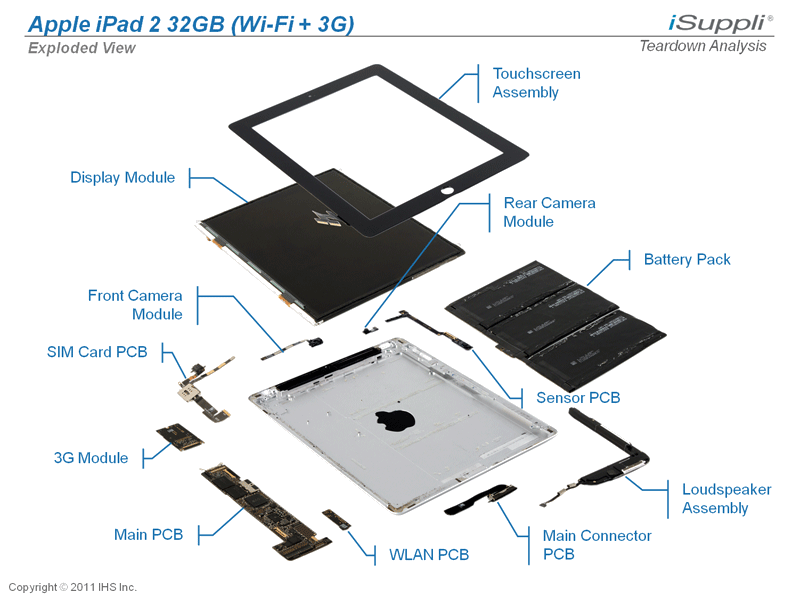
    In particular, iSuppli is reporting that its teardown analysis of the iPad 2 so far has been able to identify the following parts sourced from Japanese suppliers:

    • NAND flash from Toshiba Corp.;
    • dynamic random access memory (DRAM) made by Elpida Memory Inc.;
    • an electronic compass from AKM Semiconductor;
    • the touch screen overlay glass likely from Asahi Glass Co;
    • and the system battery from Apple Japan Inc.

    “While some of these suppliers reported that their facilities were undamaged, delivery of components from all of these companies is likely to be impacted at least to some degree by logistical issues now plaguing most Japanese industries in the quake zone,” said iSuppli’s analyst Andrew Rassweiler.

    Apple can get NAND and DRAM from other sources, notably Samsung and Micron. The battery, compass and glass are not so easily replaced.

    The batteries manufactured in Apple’s Japanese factories are unusually thin, the compass was selected to work closely with the iPad’s accelerometer and gyroscope, and the glass seems to use the new Dragontrail technology that only Asahi can supply.

    Hon Hai (Foxconn), which assembles iPads for Apple in China, is reported to have plenty of parts in hand, which helped Hon Hai’s shares rebound more than 1% in the Taiwan stock exchange Friday. Longer-term, the rate at which Hon Hai can build — and Apple can deliver — iPads may depend on how long Japan’s aftershocks and logistical problems persist.

    Piper Jaffray’s Gene Munster pointed out Wednesday that because Apple tends to buy its components in large pre-payment deals that guarantee supply and pricing, it is probably in a better position than any of its competitors to weather the storm.

  • David Letterman’s Top 10 Reasons To Buy iPad 2


    “SO THIN YOU CAN USE IT TO CHOP VEGETABLES.”

    You know a product has official hit the public’s consciousness as well as the late night shows get in on the fun. That’s just what happened as Letterman gave the latest iPad his trademarked Top 10 treatment. Apparently he’s addicted to “the damn thing.” Watch the video below:

  • Apple’s iPad 2 Smart Cover Teardown Uncovers 21 Magnets


    A total of 31 magnets are used to make the iPad 2 and its Apple-branded Smart Cover properly align, with 21 magnets found in the accessory and the remaining 10 in the iPad 2 itself.

    After they teared down the iPad 2 the team iFixit for the first time ever,  conducted a teardown of a case, a move that highlights the unique nature of Apple’s Smart Cover for the iPad 2. When the iPad 2 was first introduced, Apple touted that its accessory cover was developed alongside the new touchscreen tablet.

    The solutions provider utilized magnetic viewing film to demonstrate the magnetic poles of the material inside the Smart Cover. It found that one magnet is used to turn off the iPad 2 screen, while the rest are used to either clamp the case to the iPad 2 or form the triangle shape that allows the case to act as a stand.

    The sleep control for the iPad 2 can even be triggered with a separate magnet without using the Smart Cover, automatically enabling or disabling the screen.

    Inside the iPad 2, a row of magnets are located on the right side of the device, making the Smart Cover clamp to the surface of the device. The magnets are clearly labeled with their alternating polarity, which ensures the Smart Cover always sits in the same orientation.

    Also included in the iPad 2 are a row of magnets along the left side of the device, which allows the Smart Cover to latch onto the side and pivot to open and allow access to the screen. iFixit found that the magnets inside the iPad and its accompanying Smart Case on the left side are “very strong,” and witnessed them make a two-inch leap to connect.

    Inside the Smart Cover, iFixit found:

    • A large metal place encased in plastic that adheres to the magnets to form the stand.
    • Two yellow all-plastic plates in the middle that exist purely for structural support.
    • A stack of magnets.

    The teardown also revealed that Apple opted for a steel-to-magnet bond, which is weaker than a magnet-to-magnet bond, which is why there are a total of 21 magnets inside the case. iFixit said that Apple needed “lots more magnets to prevent the case from literally falling apart during use.”

    The Smart Case does not use any correlated magnets, which have a complex field of patterns rather than standard positive and negative polarity. The magnets used by Apple inside both the Smart Cover and iPad 2 are regular two-pole magnets.

    Last week, iFixit conducted a more traditional teardown of the iPad 2 itself. The disassembly of Apple’s latest touchscreen tablet revealed that the new device has a slightly bigger battery than its first-generation counterpart, as well as double the RAM with 512MB.