• Peter Jackson Responds to The Hobbit 48fps Controversy


    Martin Freeman as Bilbo Baggins in The Hobbit

    Martin Freeman as Bilbo Baggins in The Hobbit

    Warner Bros. screened 10 minutes footage of Peter Jackson‘s upcoming The Hobbit: An Unexpected Journey at CinemaCon, and it was screened in 48 Frames Per Second. The issue is that a lot of people seemed to be disappointed with the new projected standard. Many said that the footage was terrible and non-cinematic.

    After such complaints Director Peter Jackson recently talked to Entertainment Weekly about these concerns, and he hopes critics would change their minds after seeing the movie as a whole:

    At first it’s unusual because you’ve never seen a movie like this before. It’s literally a new experience, but you know, that doesn’t last the entire experience of the film–not by any stretch, [just] 10 minutes or so. That’s a different experience than if you see a fast-cutting montage at a technical presentation.

    I can’t say anything. Just like I can’t say anything to someone who doesn’t like fish. You can’t explain why fish tastes great and why they should enjoy it.

    There can only ever be a real reaction, a truthful reaction, when people actually have a chance to see a complete narrative on a particular film.

    However the movie, The Hobbit: An Unexpected Journey, will be showed with 6 different formats; 3D, 2D, IMAX 3D, each in 48fps and ordinary 24fps.

    Watch the trailer released earlier below:

    official Synopsis:

    “The Hobbit: An Unexpected Journey” follows title character Bilbo Baggins, who is swept into an epic quest to reclaim the lost Dwarf Kingdom of Erebor, which was long ago conquered by the dragon Smaug. Approached out of the blue by the wizard Gandalf the Grey, Bilbo finds himself joining a company of thirteen dwarves led by the legendary warrior, Thorin Oakensheild. Their journey will take them into the Wild; through treacherous lands swarming with Goblins and Orcs, deadly Wargs and Giant Spiders, Shapeshifters and Sorcerers. Although their goal lies to the East and the wastelands of the Lonely Mountain first they must escape the goblin tunnels, where Bilbo meets the creature that will change his life forever … Gollum. Here, alone with Gollum, on the shores of an underground lake, the unassuming Bilbo Baggins not only discovers depths ofguile and courage that surprise even him, he also gains possession of Gollum’s “precious” ring that holds unexpected and useful qualities … A simple, gold ring that is tied to the fate of all Middle-earth in ways Bilbo cannot begin to know.

  • Apple Responds to the new iPad Battery Overcharging Issue


    Apple Responds to the new iPad Battery Overcharging Issue

    Apple Responds to the new iPad Battery Overcharging Issue

    The issue concerning Apple‘s new iPad’s battery and its ability to charge beyond 100% was on hot water over the previous days when NBC’s John Fortt reports that Apple said charging beyond 100 percent could “harm the longevity of the battery.”

    Apple is saying when it reads 100% the battery indicator reads 100%. It’s actually full enough to give you the kind of performance that they promise in their marketing. That’s ten hours of all-day battery life. They say if you charge it more than that, you could harm the longevity of the battery. So they say this isn’t just an issue with the new iPad. It was an issue with the previous ones well but this battery is 70% bigger so you’re more likely to notice it.

    Now, however, AllThingsD seems to have a word from Apple VP Michael Tchao that put the issue in rest:

    Apple does in fact display the iPad (and iPhone and iPod Touch) as 100 percent charged just before a device reaches a completely charged state. At that point, it will continue charging to 100 percent, then discharge a bit and charge back up to 100 percent, repeating that process until the device is unplugged.

    Doing so allows devices to maintain an optimum charge, Apple VP Michael Tchao told AllThingsD today.

    “That circuitry is designed so you can keep your device plugged in as long as you would like,” Tchao said. “It’s a great feature that’s always been in iOS.”

  • Android, BlackBerry and Nokia Log Everything You Do


    Android logo

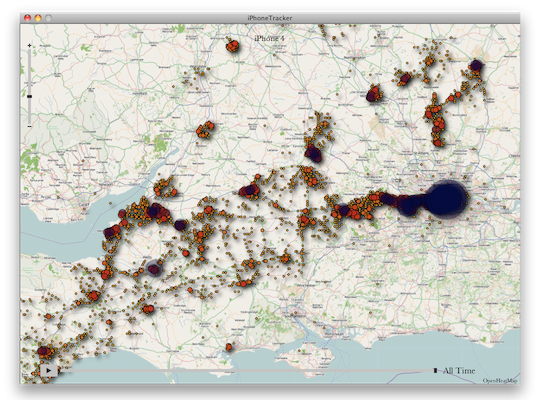
    Security researchers have discovered that iPhone running iOS 4 were storing a cache of data on which GPS locations that handset had visited in an unencrypted file, it was dubbed LocationGate and later the whole debacle was just a bug but Apple has to testify in front of the Senate about the matter

    Following the incident, one user sent an email to Apple asking for answers. If he didn’t get them soon, he said, he’d switch to Droid; they don’t track him. An email from Steve Jobs, which dropped something of a bombshell: he said Apple doesn’t track anyone’s location, but that Android tracked everyone.

    Now time has proven Steve Jobs right. Android phones do track you. In fact, software that comes pre-installed on millions of Android, BlackBerry and Nokia phones log everything you do with your device, and sends them off secretly to its own servers. Trevor Eckhart, the developer who discovered the software, released a video of his findings, watch it below.

    Carrier IQ will log and save each key dialed. When receiving a text message, Carrier IQ will process and log the text message, before the user even sees it. Web searches are stored by the service as well, logged in plain text. No encryption. That’s incredible. One privately held company that almost no one has ever heard of has the complete logs of every email, phone call, web search and text message ever sent or received by millions of Android, Blackberry and Nokia users.

    In a phone interview to Wired.com, a marketing manager for Carrier IQ defended what the product does:

    We’re not looking at texts. We’re counting things. How many texts did you send and how many failed. That’s the level of metrics that are being gathered.


    [via CultOfMac]

  • Apple Officially Addresses Location Data Controversy


    Apple officially acknowledged the growing controversy over the logging of location data on the iPhone and iPad. The document comes in a Q&A format. In it, Apple addresses some common concerns and explicitly states that they are not tracking the location of your iPhone/iPad, has never done so, and has no plans to do so.

    Why is my iPhone logging my location?

    The iPhone is not logging your location. Rather, it’s maintaining a database of Wi-Fi hotspots and cell towers around your current location, some of which may be located more than one hundred miles away from your iPhone, to help your iPhone rapidly and accurately calculate its location when requested. Calculating a phone’s location using just GPS satellite data can take up to several minutes. iPhone can reduce this time to just a few seconds by using Wi-Fi hotspot and cell tower data to quickly find GPS satellites, and even triangulate its location using just Wi-Fi hotspot and cell tower data when GPS is not available (such as indoors or in basements). These calculations are performed live on the iPhone using a crowd-sourced database of Wi-Fi hotspot and cell tower data that is generated by tens of millions of iPhones sending the geo-tagged locations of nearby Wi-Fi hotspots and cell towers in an anonymous and encrypted form to Apple.

    Apple states that all data that is transmitted to Apple is anonymous and encrypted and can not be tied to the identity of the user. They also note that findings that the database continues to grow despite Location services being off as a bug that will soon be addressed.

    Apple is planning on releasing a free iOS update in the next few weeks that performs the following:

    • Reduces the size of the crowd-sourced Wi-Fi hotspot and cell tower database cached on the iPhone,
    • Ceases backing up this cache, and
    • Deletes this cache entirely when Location Services is turned off.

    [via: macrumors]