• What Is Thunderbolt?


    Thunderbolt technology is what was Intel’s Light Peak. It’s not an Apple technology, but rather the culmination of Intel’s handiwork in combination with Apple’s mini DisplayPort. While Light Peak was developed to work over fiber (literally for light speeds), Thunderbolt is implemented over copper. Despite this, you’re still getting bi-directional (in and out as they say), 10 Gbps connection over a cable, plus a 10 Watt feed so you can power heavy equipment on the go (you don’t get that with USB). For comparison, your current USB 2.0 devices only get 480 Mbps through the cable! With this technology, you can drive multiple inputs including monitors, workstations, and audio equipment without a bird’s nest under your desk.

    What it does:

    Thunderbolt allows users to connect to monitors sport mini DisplayPort, or DisplayPort connections. Adapters can allow for HDMI, DVI, and VGA connections as well, but it doesn’t stop with these less ambitious technologies. Thunderbolt provides support for optical connections (you heard me: FIBER), to connect to high speed networks. It’s kind of insane to think about: USB 3.0 provides plug & play connections at up to 5 Gbps, yet Thunderbolt can accommodate almost any technology and possibly power a business out of a laptop. Apple and Intel are very much pushing the envelope here.

    Don’t worry about those silly terms above. Just think of it this way – data can go in & out of the cable at the same time with no waiting. Otherwise, Thunderbolt separates your display and data connections by passing your monitor input through DisplayPort, while your data is passed through the PCI Express bus. Thunderbolt is the combination of monitor and data technologies.

    How does it help me?

    For the consumer, the best part is simply this: you’ll no longer have multiple Cinema Display cables hooking to your laptop. You can still latch on your hard drives, USB sticks, and iPhone docks to your display, but because there’s such a huge amount of bandwidth with Thunderbolt, it can effortlessly slurp down one cable. Keep in mind that Thunderbolt is both giving the user display feedback, as well as shuffling bits of data around for files and music all in one tube. The idea itself isn’t new, but customer accessibility (especially in the Apple ecosystem) will simplify installation. You may not necessarily see a hard drive instantly fill up if there’s a USB connection in the middle somewhere (there would be a bottleneck at the Cinema Display for example), but the current generation of SATA III HDDs can gobble down data at 6 Gbps. Imagine if that was directly paired with Thunderbolt with or without an adapter, then plugged into your machine? It wouldn’t take long at all to clone your HDD or transfer a media center’s worth of files somewhere else.

    What if I have more than one Thunderbolt device?

    The cool part about Thunderbolt is that you can “daisy-chain” devices. So say you connect your MacBook to a Thunderbolt enabled external hard drive, but want to plug in another external hard drive via the same port. Well, instead of connecting to the MacBook, you’ll just connection to a second Thunderbolt port on your first external hard drive. Make sense? The connection will pass through subsequent devices until it reaches your Mac, but it will be instant.

  • Apple’s New Data Center Revealed to be Giant Vault


    Once again, Steve Jobs is poised to pull a surprise out of his hat.

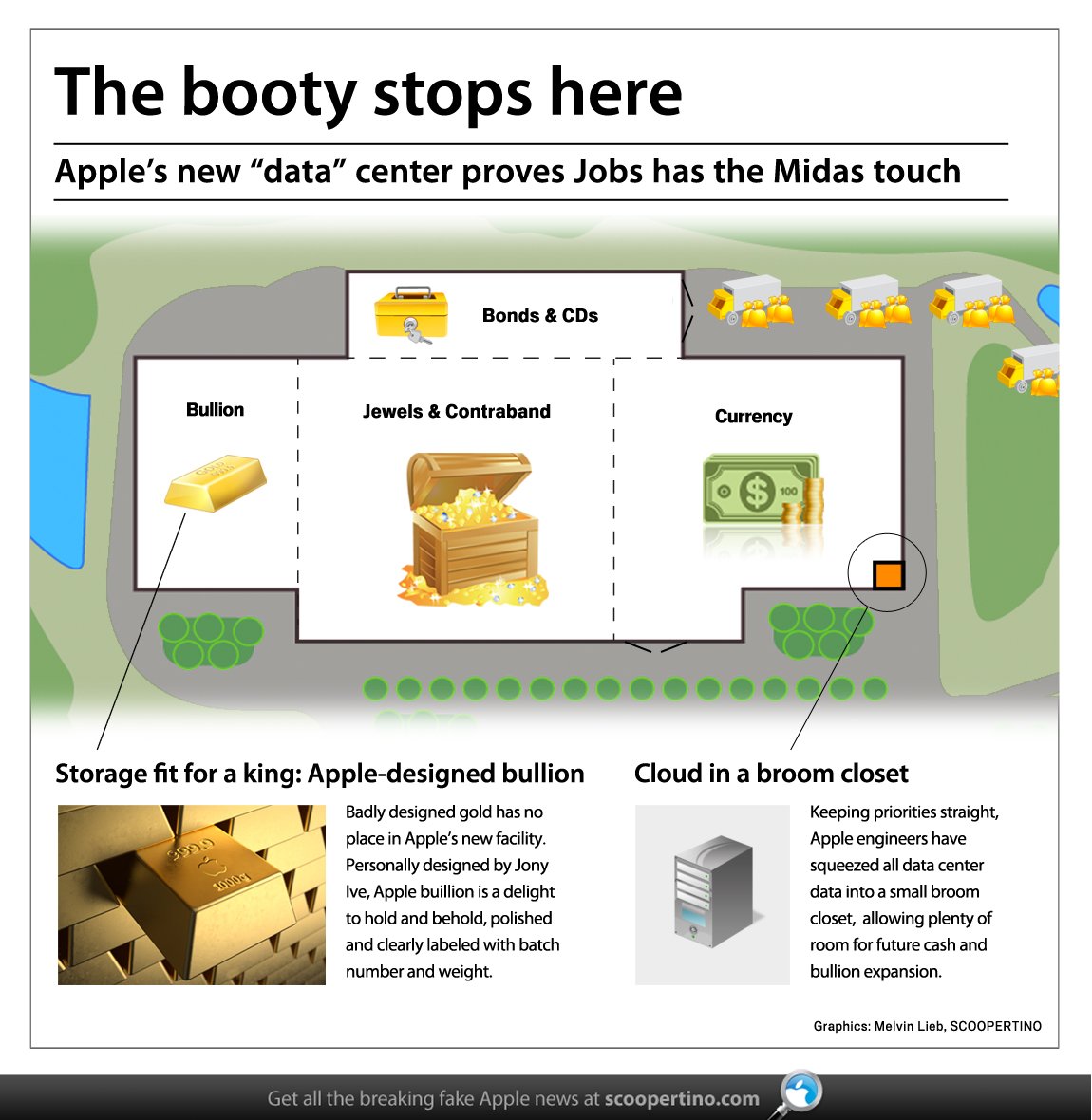
    Apple’s 500,000-square-foot North Carolina facility, long thought to be a server farm set to power the company’s cloud-based services, turns out to be nothing of the sort.

    According to the folks at scoopertino, the facility is actually the world’s largest vault — where Apple will stash the $60 billion treasure it holds in reserve.

    Each of four connected vaults are designed to hold a different type of asset. One of the largest vaults, measuring over 140,000 square feet, is dedicated to US currency — kept crisp by an advanced climate control system. Apple engineers are already at work to reduce the amount of space needed for currency, co-developing a million-dollar-bill with the U.S. Treasury.

    “Smaller” vaults (measuring 75,000 and 95,000 square respectively) will house Bonds & CDs and special Apple-designed gold bullion.
    Incoming bullion awaits an Apple-engineered smelting process to ensure that it meets the Apple gold standard

    The largest vault in the facility — covering a mind-numbing 230,000 square feet — would make Jack Sparrow blush. Here, pirate-style, Apple plans to store jewels and contraband in overflowing chests. This jives with recent rumors that Apple Stores will soon be accepting jewelry from cash-strapped patrons.

    But don’t think Apple has taken its eye off the cloud. A small broom closet near the facility’s southeast service entrance houses the servers that will provide cloud-based magic to Apple’s customers when and if the company sees fit.

    Public tours of Apple’s North Carolina facility will begin June 1st. Admission is $29, payable in cash or bullion.

  • New iPad ‘Smart Bezel’ Patent Emerged


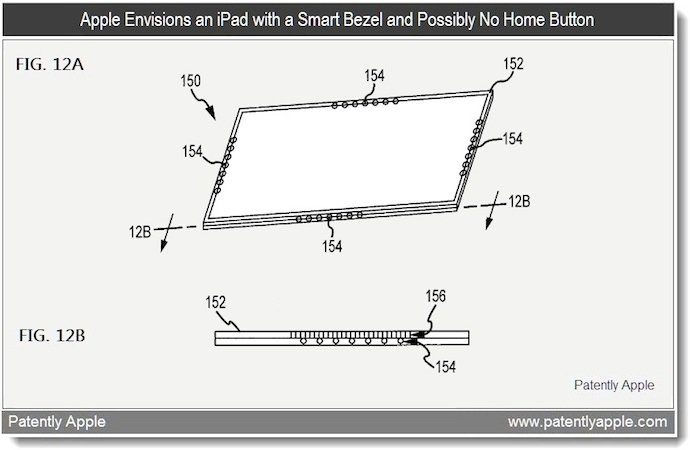
    A patent from Apple detailing a new ‘Smart Bezel’ feature for the iPad emerged. This new bezel is said to be a touch-sensitive gesture area surrounding the iPad’s display. Now, with the iPad being rumored to lose the stationary home button, it would make sense that Apple would implement something similar to what is found in the ‘Smart Bezel’ patent.

    Adding credence to this Patently Apple has uncovered yet another patent relating to the smart bezel and this patent features a tablet device with the new bezel, but the drawing does not include the home button.

    The patent describes some possible features for the bezel such as double-tapping the bezel to turn the iPad on and off, touching the bezel in certain places with certain amounts of pressures to the control brightness and volume, and touching the bezel in a certain way to lock and unlock the display.

    We think that this ‘Smart Bezel’ along with the new iPad gestures Apple is testing in iOS 4.3 would be a good replacement for their physical home button in mobile iOS products.

  • Steve Jobs to meet with President Obama Tomorrow


    Apple CEO Steve Jobs will reportedly join Google chief executive Eric Schmidt and Facebook founder Mark Zuckerberg in a meeting with US President Barack Obama in San Francisco on Thursday.

    Though recent reports have alleged that Jobs’ health has continued to decline, the executive is scheduled to attend a business leaders’ event with President Obama Thursday evening, a source told ABC News.

    Google’s Schmidt, who will step down as CEO in April; GE CEO Jeffrey Immelt, the newly named chairman of the White House Council on Jobs and Competitiveness, and Facebook’s Zuckerberg will also be in attendance, according to sources familiar with the meeting.