• Apple Sues Samsung Over Galaxy Look & Feel


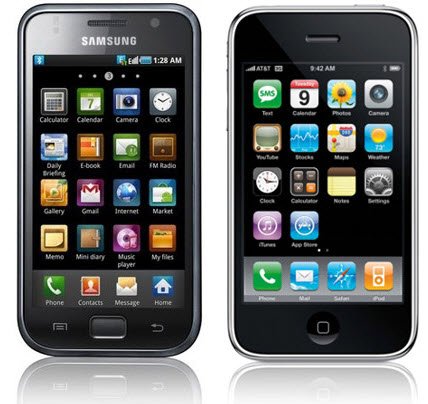
    The Wall Street Journal reports that Apple has filed a lawsuit against Samsung over the “look and feel” of Samsung’s Galaxy series. The Galaxy series includes the popular Galaxy S smartphone line – Nexus S, Galaxy S 4G, Epic 4G – in addition to the Samsung Galaxy Tab tablet device.

    Rather than innovate and develop its own technology and a unique Samsung style for its smart phone products and computer tablets, Samsung chose to copy Apple’s technology, user interface and innovative style in these infringing products, the lawsuit said.

    Samsung supplies many flash components and the basis of Apple’s A4 and A5 processors, Samsung also manufactures RAM modules and display technology for Apple.

    Mobilized has this comment from Apple:

    “It’s no coincidence that Samsung’s latest products look a lot like the iPhone and iPad, from the shape of the hardware to the user interface and even the packaging,” an Apple representative told Mobilized. “This kind of blatant copying is wrong, and we need to protect Apple’s intellectual property when companies steal our ideas.”

  • Glasses Free 3D on iPad 2 and iPhone 4 via Head Tracking


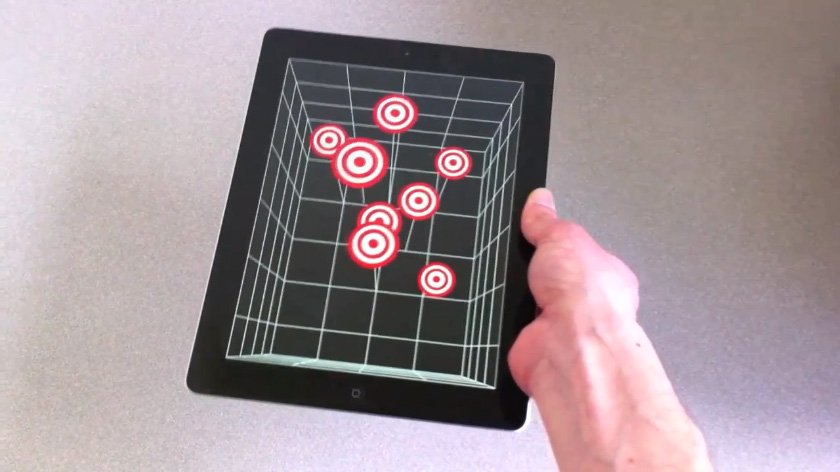
    Jeremie Francone and Laurence Nigay from the Laboratory of Informatics of Grenoble at the EHCI Research Group have created an amazing tech demoes by combining head-tracking technology that uses the iPad’s front facing camera to deliver glasses-free 3D experience that doesn’t require the accelerometer, but it’s entirely based on the camera and the movements of a user’s head in front of the screen. The position of the user will give the illusion of tridimensional objects moving on the display.

    We track the head of the user with the front facing camera in order to create a glasses-free monocular 3D display. Such spatially-aware mobile display enables to improve the possibilities of interaction. It does not use the accelerometers and relies only on the front camera.

    Francone and Nigay were inspired by the work of Johnny Lee who built a similar system using a Wii system.

    Glasses-free 3D has been deployed by Nintendo in its latest 3DS portable gaming console, and a series of reports in the past suggested Apple could implement glasses-free 3D in the future. The app does not yet appear to be available for download.

  • Adobe Unveils Creative Suite 5.5 with iPad Tools for Photoshop


    Adobe officially announced Creative Suite 5.5, a new mid-cycle upgrade for its creative applications, bringing subscription pricing and new multi-touch iPad applications for operating Photoshop.

    The Adobe Creative Suite 5.5 family marks a major change to Adobe’s product release strategy for Creative Suite. Adobe said it now plans to have milestone Creative Suite product introductions at 24-month intervals and — starting with Creative Suite 5.5 — significant mid-cycle releases.

    As part of Creative Suite 5.5, Adobe has launched a subscription-based pricing plan. Subscription Editions ensure that customers are always working with the most up-to-date versions of the software without the upfront cost of full pricing. Subscription pricing allows users to access flagship products like Adobe Photoshop for as little as $35 per month, Adobe Design Premium CS 5.5 for $95 per month, or Adobe Creative Suite 5.5 Master Collection for $129 per month.

    In addition, Adobe announced three new iPad applications that demonstrate the creative possibilities of using tablets to drive common Photoshop workflows — Adobe Color Lava for Photoshop, Adobe Eazel for Photoshop and Adobe Nav for Photoshop. THese are designed to enable users to create custom swatches, paint and drive popular Photoshop tools from tablet devices.

    The applications are a part of the Photoshop Touch Software Development Kit, which allows developers to create mobile and tablet applications that interact with Adobe Photoshop CS5 and Photoshop CS5 Extended software. The Photoshop Touch SDK and new scripting engine will allow Android, BlackBerry Tablet OS and iOS applications to drive and interact with Photoshop on the desktop.

    [via: Appleinsider]

  • New Fuji Mountain Wallpaper in Mac OS X Lion Hints at Future Retina Displays Mac


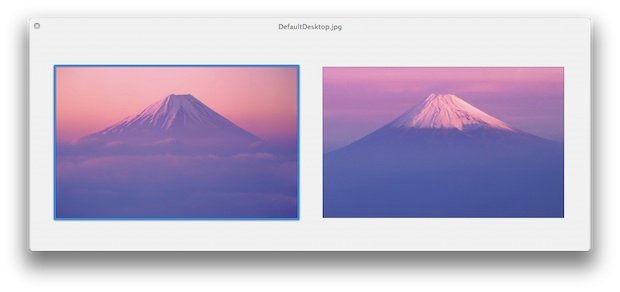
    The new default wallpaper on OS X 10.7 Lion Developer Preview 2 featuring Fuji Mountain has a whopping size of 3200×2000 pixels as noted by the guys at osxdaily.com.

    Click here to download the full version, [3200×2000 pixels.]

    However, 3200×2000 pixels is significantly larger than any existing resolution offered by Apple displays, including the 27″ and 30″ Apple Cinema Displays. Furthermore, the default wallpaper size in Mac OS X 10.6 is 2560×1600, which is exactly the maximum resolution of Apple’s 30″ Cinema Display. Is it just coincidence that Apple is bundling an ultra high resolution image in Lion as the new default wallpaper, or does this suggest that higher resolution Macs, possibly with retina displays, are coming sometime in the future?

    Here’s a nice chart that shows what screen size at what viewing distance with that resolution would be considered a retina display:
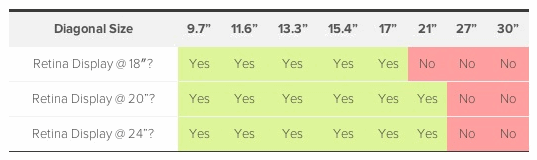
    Notice that even for the closest viewing distance of 18 inches, a 3200 x 2000 resolution represents a Retina Display for display sizes up to and including 17 inches. And of course, that covers the entire range of Apple laptops on the market today.

    And smaller displays wouldn’t need a resolution that high to be considered retina:

    A 13.3” MacBook Air, for example, would need a screen providing approximately 2200 x 1375 pixels (191 dpi) to be considered a Retina Display at an 18-inch viewing distance.

    To help understand what a “Retina Display” means. Steve Jobs, at the announcement of the iPhone 4, had this description:

    It turns out there’s a magic number right around 300 pixels per inch, that when you hold something around to 10 to 12 inches away from your eyes, is the limit of the human retina to differentiate the pixels.

    Other than providing dramatically improved display clarity on a Mac, the other reason a Mac with a 3200×2000 pixel resolution makes sense is for iOS developers. So what does this have to do with iPad 3?

    … according to an analyst cited by AppleInsider, the high resolution retina display will come to iPad 3 in the form of a whopping 2048×1536 resolution display. If this happens, you’d expect similar displays to come to the Mac platform so that developers can accurately produce and test apps for the ultrahigh resolution.

    Indeed, 3200×2000 would be such an ultrahigh resolution for a Mac, and it would be more than adequate to develop for a 2048×1536 pixel iPad 3 display.

    Sure, this is speculation based on a new wallpaper in a developer preview OS, but who knows what Apple is prepping for us.