• Apple’s iOS Is More Secure Than Google’s Android!


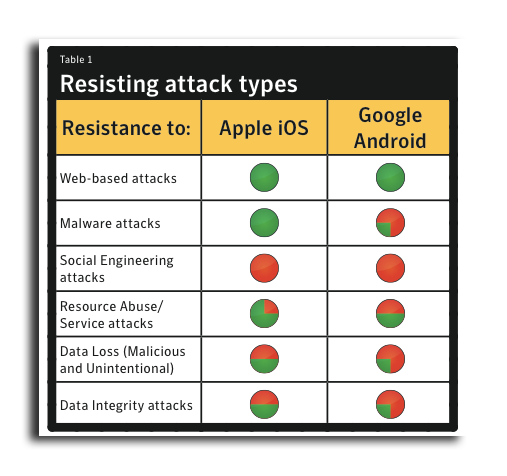
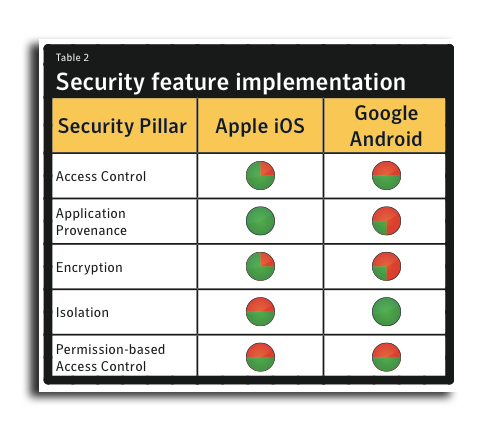
    An interesting report run by security experts at Symantec indicates that Apple iOS devices are much “less prone” to most security risks than Google’s Android platform.

    For its closed app distribution nature, the iOS is more secure and its increased resistance to resource abuse, data loss, and data integrity attacks among the factors.

    In a head-to-head comparison, Symantec found that iOS was just more secure in many areas, and was found, contrary to their findings regarding Android, to have full protection against malware attacks. Apple’s platform was also found to have greater security feature implementation in the categories of access control, application provenance, and encryption.

    The report also applauds Apple for their thorough and excellent job in designing the non-interface aspects of iOS. Check out the full report in all of its detail over at Symantec.

    [via mactrast]

  • GoDaddy Sold for $2.25 Billion By Three Private Equity Firms


    GoDaddy, the world’s largest domain registrar, has been sold to three private equity firms in a deal valued at $2.25 billion, the company announced late Friday.

    Private equity firms KKR & Co., Silver Lake Partners and Technology Crossover Ventures sealed the deal, where they agreed to take on GoDaddy’s debt, which the amounts are roughly half the value of the deal.

    “We are partnering with KKR, Silver Lake and TCV because of their technology expertise, their understanding of web-based businesses and because their values align with ours,” GoDaddy Chief Executive and founder Bob Parsons .

    Company founder and CEO Bob Parsons predicted further growth of GoDaddy under its new ownership. He said to the Los Angeles Times, “What these guys see is a company with a lot more potential internationally and more potential to make partnerships and acquisitions. They’ll help us finance and they’ll help us recruit talent.”

    GoDaddy, has seen significant growth over the past three years, with sales rising by 25% to $947 million from 2009 to 2010. The company projected growth for 2011 to continue that trend, quoting a figure of $1.1 billion for the year.

    The New York Times, in an article quotes Parsons as saying “This isn’t a sale. It’s a partnership that’s reinvesting in Go Daddy.” The article added that Parsons “will become executive chairman of the company after the sale closes, and he will remain a large stakeholder,” but it’s still unclear whether Parsons will retain a controlling interest in the company. GoDaddy’s own press release doesn’t address that crucial fact, either. We’ve contacted Parsons’ office for verification.

    A spokesperson from the Go Daddy Group, Inc. responded to mashable, stating that, “Mr. Parsons will continue to be the largest single shareholder, even after the agreement is finalized. This does not mean he has 51% — it means, as an individual, he would have as much ownership as any one entity.”

  • Microsoft is Square, Apple is Roundrect, Nokia is Squircle, Google is…?


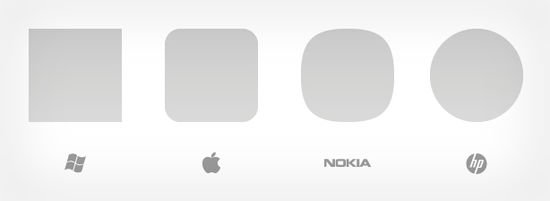
    Clayton Miller’s Interuserface takes a look at the iconic shapes behind today’s biggest mobile companies, and while Apple, iPhone, and iPad are obviously roundrects (rounded rectangles), their competition is just as geometrically aligned:

    Microsoft’s Metro UI owns the square. Apple has a corner on the roundrect, from the Springboard launcher to the iPhone hardware itself. Nokia, despite its late entry with MeeGo’s Harmattan UI, found the squircle unclaimed and ran with it beautifully. Palm has used the circle from the early days of PalmOS, and in WebOS, HP continues the tradition with care (one might even note that both Palm and HP structure their wordmarks around the circle).

    The power of shapes:

    Like color, which also despite limitless associations has a history of strong associations within a market, shape is a powerful, yet subtle differentiator. Owning a shape isn’t easy – by itself, as demonstrated by Samsung and RIM, a shape is hardly potent. Those who have successfully laid claim to a shape have used it as a building block rather than as window dressing. Use the power of shape to reinforce good design with coherence and identity – and that shape may one day be yours.

    Zune, obviously, couldn’t hold the squircle, and neither Bada nor RIM could take the square or roundrect as their own. Interestingly, Google’s Android has no iconic hold on any simple shape (nor do Facebook or Amazon for that matter, who have elected to stick with letters).

  • iPhone 5 and iPad 3 Parts Being Prepared For October Release?


    DigiTimes is reporting that the supply chain for not only the iPhone 5 but iPad 3 is beginning to prepare materials for production of the two devices. Both devices are likely to make their debuts in September and to hit the market in October, according to industry sources.

    iPhone 5’s supply volume is estimated to be around 6-7 million units in the third quarter and with the addition of iPhone 4 shipments, total iPhone shipments in the quarter will reach 24-25 million units with volumes to maintain at the same level in the fourth quarter. In 2011, Apple is forecasted to ship over 85 million iPhones.

    Upstream component makers including Foxconn Electronics (Hon Hai Precision Industry), which is in charge of assembling the devices; Simplo Technologies and Dynapack International Technology, in charge of manufacturing batteries; TPK Holding and Wintek, in charge of touch panel modules; Catcher, in charge of chassis; and Largan Precision, in charge of webcams, are all expected to benefit from the orders.

    DigiTimes has somewhat of a hit-and-miss record of Apple related rumors, while the iPhone 5 is expected, the iPad 3 release is somehow questionable. Previous rumors pointed out to two iPad will make their releases this year, so this might work this time.