• Apple’s iPad 2 Smart Cover Teardown Uncovers 21 Magnets


    A total of 31 magnets are used to make the iPad 2 and its Apple-branded Smart Cover properly align, with 21 magnets found in the accessory and the remaining 10 in the iPad 2 itself.

    After they teared down the iPad 2 the team iFixit for the first time ever,  conducted a teardown of a case, a move that highlights the unique nature of Apple’s Smart Cover for the iPad 2. When the iPad 2 was first introduced, Apple touted that its accessory cover was developed alongside the new touchscreen tablet.

    The solutions provider utilized magnetic viewing film to demonstrate the magnetic poles of the material inside the Smart Cover. It found that one magnet is used to turn off the iPad 2 screen, while the rest are used to either clamp the case to the iPad 2 or form the triangle shape that allows the case to act as a stand.

    The sleep control for the iPad 2 can even be triggered with a separate magnet without using the Smart Cover, automatically enabling or disabling the screen.

    Inside the iPad 2, a row of magnets are located on the right side of the device, making the Smart Cover clamp to the surface of the device. The magnets are clearly labeled with their alternating polarity, which ensures the Smart Cover always sits in the same orientation.

    Also included in the iPad 2 are a row of magnets along the left side of the device, which allows the Smart Cover to latch onto the side and pivot to open and allow access to the screen. iFixit found that the magnets inside the iPad and its accompanying Smart Case on the left side are “very strong,” and witnessed them make a two-inch leap to connect.

    Inside the Smart Cover, iFixit found:

    • A large metal place encased in plastic that adheres to the magnets to form the stand.
    • Two yellow all-plastic plates in the middle that exist purely for structural support.
    • A stack of magnets.

    The teardown also revealed that Apple opted for a steel-to-magnet bond, which is weaker than a magnet-to-magnet bond, which is why there are a total of 21 magnets inside the case. iFixit said that Apple needed “lots more magnets to prevent the case from literally falling apart during use.”

    The Smart Case does not use any correlated magnets, which have a complex field of patterns rather than standard positive and negative polarity. The magnets used by Apple inside both the Smart Cover and iPad 2 are regular two-pole magnets.

    Last week, iFixit conducted a more traditional teardown of the iPad 2 itself. The disassembly of Apple’s latest touchscreen tablet revealed that the new device has a slightly bigger battery than its first-generation counterpart, as well as double the RAM with 512MB.
  • iPhone 5 Will Not have Near Field Communication (NFC) Technology


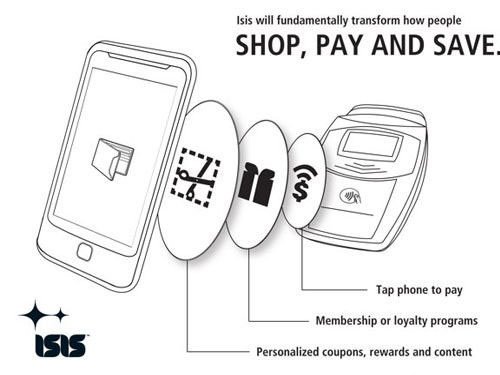
    Apple has informed their European iPhone carriers that the next-generation iPhone, as the Independent states, will not include Near Field Communication (NFC) technology. Apple is reluctant to include the technology and introduce a new “wave and pay” system due a “lack of a clear standard across the industry.”

    The iPhone 5 not having NFC technology does not mean Apple isn’t working on their own NFC service for a 2012 launch.

    Apple is understood to be working on its own NFC proposition, which would link payments through iTunes. It hopes to introduce the technology in a handset likely to be released next year.

    Apple was rumored to include this NFC technology in their just released iPad 2, and that same report from Bloomberg noted the iPhone 5, too, will include the NFC technology.

  • iPad 2 Teardown: Glass is 27 Percent Thinner


    iFixit has posted a detail teardown of the just released iPad 2, revealing a great deal about the inner working of the latest creation from Apple. The iPad 2′s glass is significantly thinner than the previous iPad. More from iFixit:

    • We did a quick glass and LCD thickness comparison:
      • iPad 1: lcd = 3.2 mm glass = .85 mm
      • iPad 2: lcd = 2.4 mm glass = .62 mm
    • The thickness of these components — especially that of the glass — could drastically reduce the durability of the device, especially the glass’ resistance to shattering. We’ll see in due time if the percentage of folks with broken iPad 2 front glass is dramatically different than that of the original iPad.
    • Lifting off the LCD exposes the iPad 2′s battery. We found a 3.8V, 25 watt-hour unit. That’s just a hair more than the original iPad’s 24.8 watt-hours, so any improved battery performance should be attributed to software and other hardware improvements.
    • We confirmed via software that the iPad 2 indeed has 512 MB of RAM.
    • The markings on the 1 GHz Apple A5 dual-core processor appear to be Samsung’s, but Chipworks will investigate in the forthcoming days to find out for sure.
    • Other components that power the iPad 2:
      • Toshiba TH58NVG7D2FLA89 16GB NAND Flash
      • Broadcom BCM5973KFBGH Microcontroller
      • Broadcom BCM5974 CKFBGH capacitative touchscreen controller
      • Texas Instruments CD3240B0 11AZ4JT touchscreen line driver
      • Broadcom BCM43291HKUBC Wi-Fi/Bluetooth/FM tuner combo chip
      • S6T2MLC N33C50V Power Management IC
      • ST Micro AGD8 2103 gyroscope
      • ST Micro LIS331DLH accelerometer
    • There’s also an Apple-branded 338S0940 A0BZ1101 SGP chip. This looks like the Cirrus audio codec Chipworks found in the Verizon iPhone, but they’ll have to get it off the board to make sure!

  • Untethered Jailbreak To Be Postponed Until Apple Releases iOS 4.3.1


    After the successful iOS 4.3 Untethered Jailbreak (video below), the hacker behind the exploit seemingly will hold his jailbreak until Apple releases iOS 4.3.1.

    With Apple already baking 4.3.1 the first one releasing an iOS 4.3 jailbreak will pretty much burn the exploit 😛

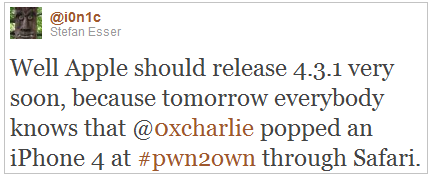
    Well Apple should release 4.3.1 very soon, because tomorrow everybody knows that @0xcharlie popped an iPhone 4 at #pwn2own through Safari.

    The hacker expected that Apple will release iOS 4.3.1 specially after the hackers (at Pwn2Own contest) has successfully hacked iPhone 4 via vulnerability which found in Mobile Safari running iOS 4.2.1.

    [Tweets [1], [2]]