How would you feel if you found an iPad on a train and took it home, only to find a near-six-foot tall rugby player (think, American football for seriously tough guys) hammering on your door, demanding it back? That’s precisely what happened yesterday when UK sports celebrity and former England rugby captain, Will Carling, OBE, left his iPad on the train. Fortunately he had MobileMe’s Find My iPhone feature enabled, so he was able to find his device — and he wrote all about it on Twitter. I caught up with him to chat about what happened next.
“At first I thought: ‘leaving it on the train, you idiot! That’s that then,'” Carling (45) told me. But a funny thing had happened one month before.
“I was having lunch with a friend. He was telling me this story of how his iPad had been stolen from his kit bag at the gym. He hadn’t enabled the tracking feature on it, so he couldn’t find it. I asked him if tracking worked, and he said, ‘Yes, very well’, so we set it up on my iPad over lunch.”
Carling was captain of England between 1988 to 1996, winning 72 caps. He’s an incredibly keen Twitter user, with over 45,000 followers. He’s a keen blogger, too.
Carling uses Macs at home — his two eldest kids are “Apple obsessives” and the family share a “big-screen iMac” in the kitchen. “I think Apple make great bits of kit,” he says, “they’re great looking.” It’s not all Apple love, though — he prefers his BlackBerry to an iPhone.
For the last six months he’s been using his iPad to keep up with business, for email, to check news reports, business correspondence using DropBox, and, erm, Angry Birds. “I’m obsessed with Angry Birds,” he told me.
Tracking it down
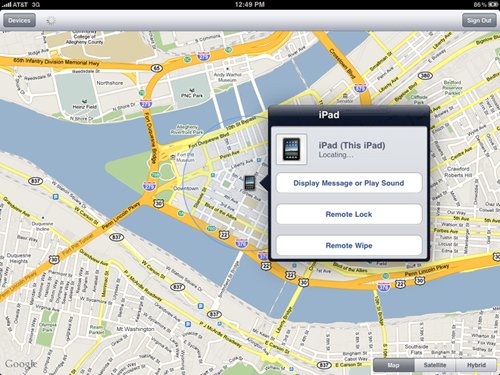
Annoyed at his stupidity on leaving his Apple device on the train, Carling thought he’d give the tracking feature a try. He logged in to MobileMe and, after about a minute, a map popped up with a blue dot showing him where his iPad was.”
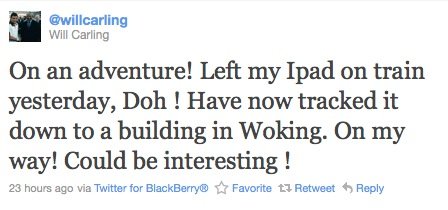
“It was a hundred yards from Woking train station,” he said, admitting he thought it was a lost property office at first. “When I got there I found it was a block of flats (apartment block) and I thought, ‘Hmm, this will be slightly more interesting.” Oblivious to consequences, Carling set off to track his iPad down.
The former rugby player got inside the block (“I didn’t break in,” he stressed), and knocked at each of the 18 doors inside. “Not one person answered the door,” he said, though he laughed when asked how he might react if a mid-40’s, near six-foot tall tough guy hammered at his front door.
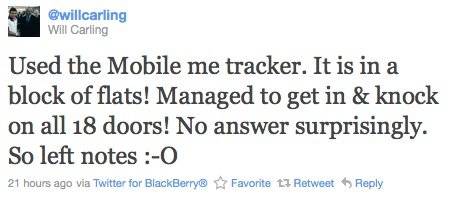
He left notes under the door of all 18 apartments, asking for the return of his property, drove home and logged in once again, watching his iPad on the map.
The iPad detective
“Five minutes later I saw it start to move,” he told me. “It was bizarre,” he said.
Talking to his Twitter horde, he wrote, “Breaking news! My iPad has moved! It is now at the station! This is like Enemy of the State !!” He’d called the cops to inform them his iPad had gone missing at this point, and began sending messages to the device.
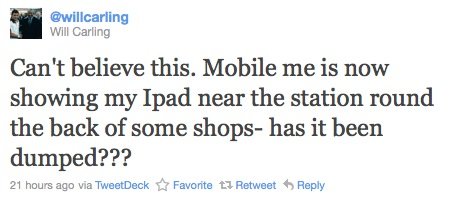
Carling panicked a little when he saw his iPad taking a route down the alley behind some shops, “I wondered if it had been dumped,” he said. He sent the iPad a message telling whoever had the device that they were being tracked along with the police crime reference number.
Apple’s Find My iPhone/iPad solution doesn’t just track your device on the map, it also lets you send messages to the device which pop up on its screen, even if it is locked. You can even use the technology to erase the data on your lost gadget in order to preserve your confidential data.
Carling didn’t need to do this. His message seemed to work. Ten minutes later and Carling could see the iPad moving toward the police station, “Feel like a real spy”, he Tweeted. “It was really quite weird watching it move across town on the screen on my Mac,” he said.
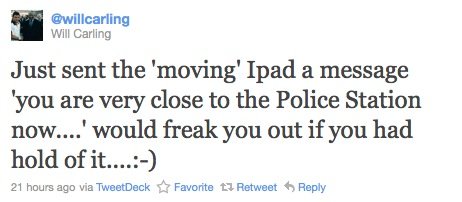
Eager to offer a little positive reinforcement, and perhaps a little excited at the ability to send scary messages to whoever had hold of his device, he sent another, “You are very close to the Police Station now.” A few minutes later the police called Carling to let him know his iPad had been handed in. An hour passed and, “just picked up iPad. Big thanks to [the police and] MobileMe,” he Tweeted.
“Are you going to be more careful in future, or did you enjoy the chase so much you might just start leaving it around for the thrill of it?” I asked him.
“Loads of people on Twitter were saying, ‘go on, lose it again, it was very entertaining,'” he said, “But I’ll be more careful next time.”
Better than Android?
This is great for the iPad and the iPhone, but it does raise the question — why does Apple not yet offer a similar service to track down lost Macs? The technology to achieve this already exists, so it can be done. If anyone at Apple were listening, I’d observe that many MacBook Pro owners would see a service like that as enough to justify an annual subscription to MobileMe.
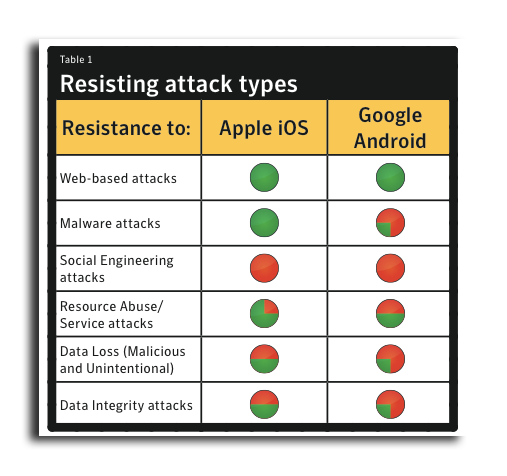
Android owners, I’ve had a look for similar solutions for your devices. I can’t seem to find any with the same simple power. Most just send you a text with geographical coordinates when you ask for them. You don’t get the real-time view or facility to delete data or message your device.
What would you have done if you’d received these messages on your iPad?
[via: Jonny Evans]