• Android Malware Has Increased 472% Since July


    In a report by the Juniper Global Threat Center has found that Android malware has increased by 472% since July of this year. They also pointed out that this October and November were the months that showed the fastest growth of mobile malware on Android ever.

    Android malware increases

    Juniper’s report includes 400% increase in Android malware from 2009 to the summer of 2010. In August, detected malware samples increased by 10%, then by 18% in September. October saw a 110% increase on top of the previous month, and November has so far seen a 111% increase. Check out the infographic below

    By comparing to Apple’s App Store, the open-ended nature of the latter, as well as the lack of any code-signing and checking process in Google’s Market are to be blamed.

    “These days, it seems all you need is a developer account, that is relatively easy to anonymize, pay $25 and you can post your applications,” wrote Juniper in its report. “With no upfront review process, no one checking to see that your application does what it says, just the world’s largest majority of smartphone users skimming past your application’s description page with whatever description of the application the developer chooses to include.”

    As mentioned by Appleinsider, an August report from McAfee found that Android had become the most-targeted platform for malware while iOS was untouched.

    In addition to an increase in the volume, the attackers continue to become more sophisticated in the malware they write. For instance, in the early spring, we began seeing Android malware that was capable of leveraging one of several platform vulnerabilities that allowed malware to gain root access on the device, in the background, and then install additional packages to the device to extend the functionality of the malware.

    In addition to this, 55% of threats are spyware-based attacks that send private data and take control of devices, while 44% are trojans that send text messages to services that charge the user.

    Is this a valid reason for users to opt for iOS devices. What do you think?

  • 800 out of 10,000 Android Apps Leak Private Information


    Android has had its fair share of malware problems. Whenever malware are detected, Google reacts swiftly and remove them. However, according to a report from Digitizor, security researcher Neil Daswani, around 8% of the apps on the Android market are leaking private user data.

    Neil Daswani, who is also the CTO of security firm Dasient, says that they have studied around 10,000 Android apps and have found that 800 of them are leaking private information of the user to an unauthorized server. Neil Daswani is scheduled to present the full findings at the Black Hat Conference in Las Vegas which starts on July 30th.

    This malware problem on Android has become too much. One of the main reason that we see malicious apps in the market is because of the lack of regulation in the apps that get into the Android Market.

    Sure, the lack of regulation can be good. It means that developers can make their apps without worrying if Google will accept their apps or not. It fits into the pre-existing application distribution model where anyone can develop and publish their own apps.

    I think that it is time that Google make approval of the apps a requirement before it gets into the Market. They do not need to do it like Apple, but a basic security check before an app gets on the market will be nice.

  • Google Will Help Protect Your Computer from Malware


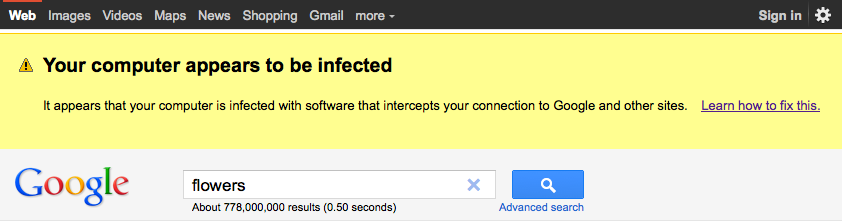
    Google has been able to detect a large number of computers infected with a specific piece of malware. If you go to Google and do a search (any word will do) right now, check to see whether you get a “Your computer appears to be infected” warning at the top of the search results. If you see the message, you need to clean up the infection from your machine.

    As we work to protect our users and their information, we sometimes discover unusual patterns of activity. Recently, we found some unusual search traffic while performing routine maintenance on one of our data centers. After collaborating with security engineers at several companies that were sending this modified traffic, we determined that the computers exhibiting this behavior were infected with a particular strain of malicious software, or “malware.” As a result of this discovery, today some people will see a prominent notification at the top of their Google web search results:

    This particular malware causes infected computers to send traffic to Google through a small number of intermediary servers called “proxies.” We hope that by taking steps to notify users whose traffic is coming through these proxies, we can help them update their antivirus software and remove the infections.

    You can run a system scan on your computer yourself by following the steps mentioned here. This is malware that’s specific to Windows.

  • LulzSec Hacks Into The Sun With Murdoch Death Notice


    Hacker group LulzSec has just hacked into one of Rupert Murdoch‘s paper’s websites, putting the mogul’s death-by-palladium note on The Sun page. The group announced the hack with a tweet, saying:

    We have joy we have fun we will mess up Murdoch’s Sun: http://t.co/JArvwg1 | Hi Rupert! Have fun tomorrow at the Parliament! #AntiSec

    Murdoch‘s papers of course, and several of his lieutenants have been implicated in the massive hacking scandal that began earlier this month. Murdoch is scheduled to appear before the British parliament tomorrow.

    Despite previous claims of retirement, LulzSec claimed in a tweet that visits to The Sun‘s homepage redirected to the Murdoch death notice page, though that no longer appears to be the case. And in case it gets taken down soon, here’s the full text:

    Media moguls [sic] body discovered

    Rupert Murdoch, the controversial media mogul, has reportedly been found dead in his garden, police announce.
    Murdoch, aged 80, has said to have ingested a large quantity of palladium before stumbling into his famous topiary garden late last night, passing out in the early hours of the morning.
    “We found the chemicals sitting beside a kitchen table, recently cooked,” one officer states. “From what we can gather, Murdoch melted and consumed large quantities of it before exiting into his garden.”

    Chemicals found in house

    Authorities would not comment on whether this was a planned suicide, though the general consensus among locals and unnamed sources is that this is the case.
    One detective elaborates. “Officers on the scene report a broken glass, a box of vintage wine, and what seems to be a family album strewn across the floor, containing images from days gone by; some containing handpainted portraits of Murdoch in his early days, donning a top hat and monocle.”
    Another officer reveals that Murdoch was found slumped over a particularly large garden hedge fashioned into a galloping horse. “His favourite”, a butler, Davidson, reports.
    Butler Davidson has since been taken into custody for additional questioning.

    Here’s the full page image caught by Gizmodo before it pulled down:

    Â