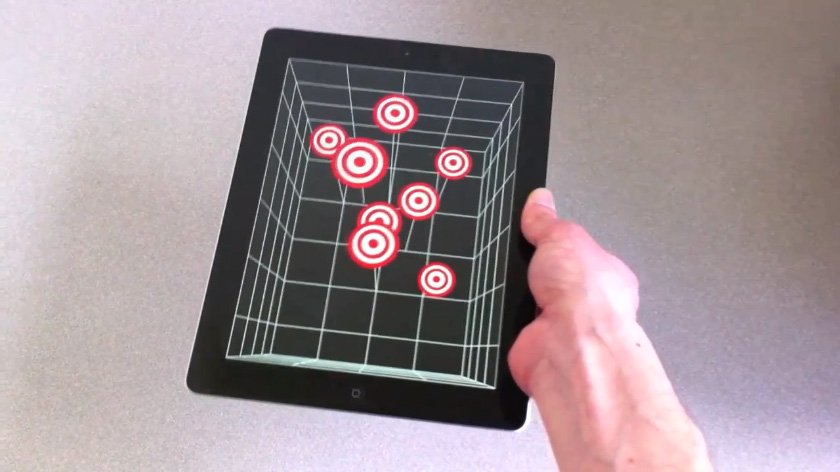
• Glasses Free 3D App For iPhone 4 & iPad 2 Free Download


    Do you remember the Glasses Free 3D on iPad 2 and iPhone 4 via Head Tracking Demo? If you don’t, no worries the video is embedded below, but in short, a research team came up an amazing tech demoes by combining head-tracking technology that uses the iPad’s front facing camera to deliver glasses-free 3D experience that doesn’t require the accelerometer, but it’s entirely based on the camera and the movements of a user’s head in front of the screen. The position of the user will give the illusion of tridimensional objects moving on the display. Now that team has released the free i3D app, so you can see the 3D illusion effect yourself.

    Apps official description:

    i3D is an overview of Head-Coupled Perspective (HCP) on iOS devices. HCP uses the front camera of the device to track the face of the user in real time. This information tells the app how the user is looking at the display. The app updates the perspective of the 3D scene accordingly, giving the user the illusion that he looks at a small window.

    i3D contains several 3D scenes that you can observe with HCP. It only relies on face tracking. It does not use the accelerometers or the gyroscopes.

    The face tracking system does not detect and track the face in every lighting condition. Read the instructions in the app to get a good tracking.

    Head-Coupled Perspective does not create a stereoscopic display! It provides a kind of monocular 3D display: the same picture is seen by both eyes. In the future, it might be combined with a stereoscopic display for a better 3D effect.

    i3D has been developed by Jeremie Francone and Laurence Nigay at the Engineering Human-Computer Interaction (EHCI) Research Group of the Grenoble Informatics Laboratory (LIG), University Joseph Fourier (UJF).

    Here is the original video to watch it again:
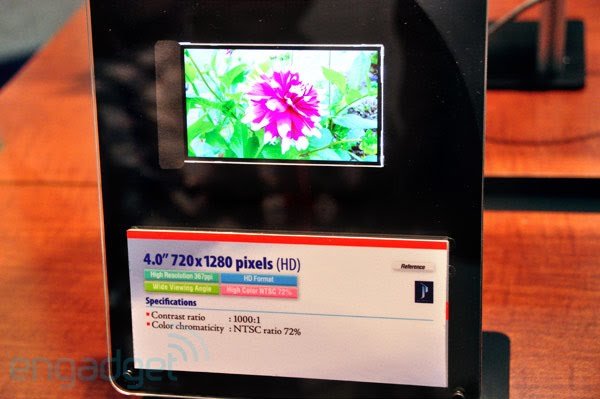
  • Toshiba Shows off 4-inch 367dpi 720p Resolution Retina Display Panel


    Toshiba has indeed made a lot of hype over revealing last week their new four-inch LCD display that incorporates 367 pixels-per-inch density, runs at 1280 x 720 pixel resolution natively. Today, Engadget had a chance to spend some time with Toshiba’s new entry at SID 2011, and here what they had to say about the new display panels:

    We got the lowdown on Toshiba’s latest four-inch LCD a couple of days ago, and today at SID 2011 we got up close and personal with the pixel-packed display. It’s one thing to read about a 367ppi screen that shows native 720p video, and it’s quite another to experience it in person. We can report that it is, in fact, as awesome as it sounds — onscreen images were clear, crisp, and chromatically brilliant. Pixel density enthusiasts will also be happy to hear that Toshiba confirmed the display will make it to market this year. Of course, the rep wouldn’t tell us which phone will take the iPhone 4’s crown as the ppi champ, though we imagine it’ll be something powered by little green bots.

    They have recorded a small footage that you can watch below:

  • Apple Thinks Smaller is Always Better. Apple Introduces a Nano SIM Card Design


    Reuters reports that Apple has proposed a nano SIM card design smaller than the micro-SIM currently used in the iPhone 4 and iPad, the new design won the backing of French giant carrier Orange. The design allows Apple and other companies adopting the card to design smaller and thinner devices.

    “We were quite happy to see last week that Apple has submitted a new requirement to (European telecoms standards body) ETSI for a smaller SIM form factor — smaller than the one that goes in iPhone 4 and iPad,” said Anne Bouverot, Orange’s head of mobile services.

    “They have done that through the standardisation route, through ETSI, with the sponsorship of some major mobile operators, Orange being one of them,” she told the Paris leg of the Reuters Global Technology Summit.

    With finalization of the standard and technical issues still to be worked out, devices using the smaller SIM card could hit the market next year.

    This is a great news and for Apple smaller and thinner is always better. This comes in bar with rumors speculated that Apple will introduce nano iPhones in the future. However, Don’t expect the new SIM until 2012, at the very earliest

  • Steve Jobs to Nike CEO: ‘Get Rid of the Crappy Stuff’


    Carmine Gallo shares this interesting story on Forbes, shortly after becoming CEO, Mark Parker talked to Steve Jobs on the phone asking for some tips:

    “Do you have any advice?” Parker asked Jobs. “Well, just one thing,” said Jobs. “Nike makes some of the best products in the world.  Products that you lust after.  But you also make a lot of crap.  Just get rid of the crappy stuff and focus on the good stuff.”

    Jobs was “absolutely right,” Parker admitted, adding that Nike “had to edit” when making business decisions:

    Parker said Jobs paused and Parker filled the quiet with a chuckle.  But Jobs didn’t laugh.  He was serious. “He was absolutely right,” said Parker.  “We had to edit.”

    Parker used the word ‘edit’ not in a design sense but in the context of making business decisions.  Editing also leads to great product designs and effective communications. According to Steve Jobs, “People think focus means saying yes to the thing you’ve got to focus on.  But that’s not what it means at all.  It means saying no to the hundred other good ideas that there are. You have to pick carefully.  I’m actually as proud of the things we haven’t done as the things I have done.  Innovation is saying ‘no’ to 1,000 things.”

    But “Can anyone innovate like Apple?”

    The simple answer: While anyone can learn the principles that drive Apple’s innovation, few businesses have the courage to do so.  It takes courage to reduce the number of products a company offers from 350 to 10, as Jobs did in 1998.  It takes courage to remove a keyboard from the face of a smartphone and replace those buttons with a giant screen, as Jobs did with the iPhone.  It takes courage to eliminate code from an operating system to make it more stable and reliable, as Apple did with Snow Leopard.  It takes courage to feature just one product on the home page of a Web site as Apple does with each new major product launch.  It takes courage to make a product like the iPad that is so simple a child can use it.  And it takes courage to eliminate all of the words on a PowerPoint slide except one, as Steve Jobs often does in a presentation.