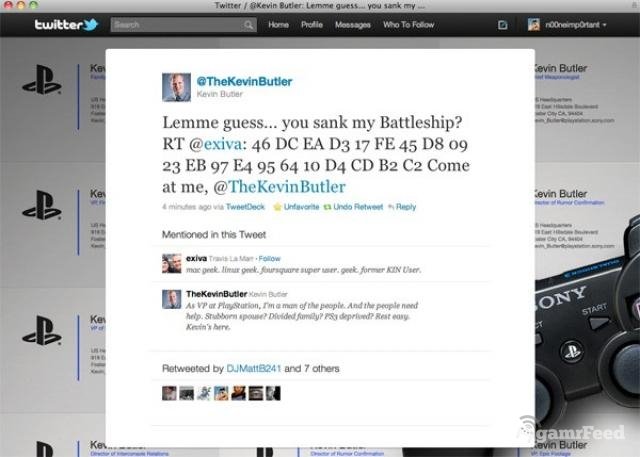
• Kevin Butler Retweets PS3 Jailbreak Code


    Sony’s awesome, yet not actually real, Vice President of, well, anything Sony PlayStation related has today made a mistake that is sure to not be forgotten for the months or even years to come.

    Travis La Marr, or “@exiva“, sent a tweet over to Kevin Butler’s Twitter account which contained the PlayStation 3 METLDR root key and more-or-less challenged the VP of everything to “Come at me.” Apparently, Kevin Butler hasn’t heard the news recently as he confused it for a Battleship reference and retweeted the code for everyone to see.

    The tweet has since been removed, but Engadget was able to snap a screenshot of the tweet, found above.


  • Verizon iPhone 4 Supports Both CDMA & GSM


    We always say that folks over iFixit are just too quick. The have already got their hands on the Verizon iPhone 4 to reveal many interesting facts. There is only one interesting thing that have found in it. The Verizon iPhone 4 uses a Qualcomm MDM6600 baseband chipset which is not only supporting CDMA but also the high-speed HSPA/ AT&T GSM.

    Only the CDMA part is enabled which means you can activate the GSM part to switch between both networks using the Verizon iPhone.

    According to the iFixit:

    “It may be that it was easier to design antennas for a CDMA-only phone-this phone supports two cellular frequency bands, while Apple supports five bands in the GSM version“.

    “This is the same chipset as the Droid Pro world phone. It supports both GSM and CDMA-which means that Apple *could* have supported GSM!”

    May be it was less complicated for them to use such infrastructure. They could have release single phone to support both networks (AT&T and Verizon) on it. It seems that iPhone 5 will also have a similar structure or may be Apple has something interesting to reveal which we cannot predict right now.

  • The Hobbit to start Shooting on March 21st


    Production company 3Foot7 Ltd, is pleased to announce that the first day of principal photography for The Hobbit will be Monday 21 March, 2011. It was supposed to start shooting this month, but director Peter Jackson was recently in the hospital for an operation, which kind of slowed down production a bit. He’s OK though, and here’s what the director had to say,

    Despite some delays we are fully back on track and very excited to get started.

    3Foot7 Ltd (who released this news) added,

    This date has been chosen following practical considerations of the filming schedule requirements, actor availability and the NZ seasons. Shooting will take place at Stone Street Studios in Miramar and on location around New Zealand.

    Confirmed cast include Martin Freeman, Ian McKellen, Richard Armitage, Ken Stott, Graham McTavish, William Kircher, James Nesbitt, Stephen Hunter, Rob Kazinsky, Aidan Turner, Peter Hambleton, John Callen, Jed Brophy, Mark Hadlow, Adam Brown, Cate Blanchett, Andy Serkis, Mikael Persbrant, Sylvester McCoy and Elijah Wood.

    The two Hobbit films will be released in December 2012 and December 2013.

  • Bing: “We Do Not Copy Results. Period.”


    The war of words between Google and Bing has escalated today with a strong denial about copied search results from Bing’s Yusuf Mehdi, who also accused Google of a form of click fraud in setting up its test involving “honeypot” search results.

    Mehdi, Microsoft’s Senior VP of Online Services, just published a strongly-worded denial of Google’s claims on the Bing Search blog:

    We do not copy results from any of our competitors. Period. Full stop. We have some of the best minds in the world at work on search quality and relevance, and for a competitor to accuse any one of these people of such activity is just insulting.

    That’s in response to yesterday’s developments in which Google accused Bing of copying its search results after running tests that involved the manual promotion of random web pages to rank for nonsense terms on Google.com. A small percentage of the test queries — 7 to 9 of about 100 tested — later produced the same page to rank on Bing.com.

    That led Bing to accuse Google of trying a ‘spy-novelesque stunt’, and Google followed up by calling Bing’s search results a ‘cheap imitation’ of Google.

    Mehdi’s post today turns the heat up more with accusations that Google’s test was a form of click fraud:

    Google engaged in a “honeypot” attack to trick Bing. In simple terms, Google’s “experiment” was rigged to manipulate Bing search results through a type of attack also known as “click fraud.” That’s right, the same type of attack employed by spammers on the web to trick consumers and produce bogus search results. What does all this cloak and dagger click fraud prove? Nothing anyone in the industry doesn’t already know. As we have said before and again in this post, we use click stream optionally provided by consumers in an anonymous fashion as one of 1,000 signals to try and determine whether a site might make sense to be in our index.

    Mehdi points out that Bing first admitted its use of click activity back in the summer of 2009 in a Directions on Microsoft report (membership required, link via SAI). He also points out that Google has been accused of copying Bing several times in the past. (He’s referring to Google image search, home page photos, and even Google’s adoption of a 3-column interface last year, which Ask.com had before both Bing and Google.)

    It’s anyone’s guess how long this war of words will go on, as both sides seem to want to have the last word. That status belongs to Bing now, but for how long?

    [source & more info at searchengineland]