• Rapportive Takes on Gmail’s People Widget


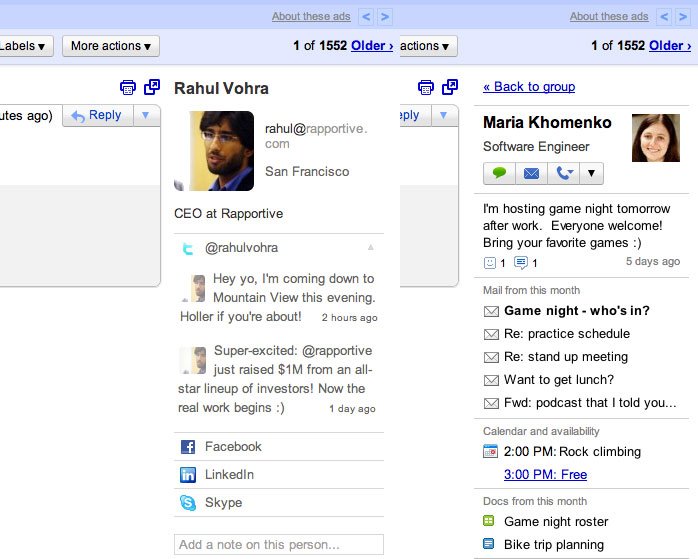
    As you might know Rapportive add-on is one of the must-have Gmail widgets that integrate natively and nicely with the mail dashboard, it shows you more contact details in the inbox for individual email along with its social ties such as Facebook, LinkedIn, YouTube, etc. in a nice sidebar.

    Last week Google unveiled The People Widget, which is being gradually rolled out to users over the next few weeks, it looks and functions remarkably similar to Rapportive’s sidebar, yet gives users more features like job titles, calendar availability, recent conversations, shared Google Docs and Buzz updates related to your email contacts in the sidebar with apparent deeper Google integration.

    Now Rapportive, in turn has responded to what many perceived as a direct attack from Google by integrating the People widget. Rapportive CEO and co-founder Rahul Vohra had to say:

    “We’re very flattered by how similar the widget is to Rapportive, In fact, some of the design details have been copied directly, from the new position of the ‘print’ and ‘new window’ icons, through to how the widget remains onscreen as you scroll.”

    “I knew it would happen sometime this year. Google has made acquisitions in this space, and social is their new mantra, I emailed our investors as soon as the news broke — I detailed how we felt, that we planned to integrate, and reminded everybody of our roadmap for the next year or so. Everybody was very positive.”

    Rapportive contact profiles will include the usual features along with the Gmail enhancements and users can get their access to the new Rapportive features as soon as they get the Gmail widget,

    [via mashable]

  • iCloud To Cost $25 Per Year After Free Trial Period


    The LATimes reports that iCloud will initially be offered free but eventually costing users $25/year subscription:

    Dubbed iCloud, the service initially will be offered for a free period to people who buy music from Apple’s iTunes digital download store, allowing users to upload their music to Apple’s computers where they can then play from a Web browser or Internet-connected Apple device.

    The company plans to eventually charge a subscription fee, about $25 a year, for the service. Apple would also sell advertising around its iCloud service.

    We reported eariler that Apple has reached agreements with the four major record labels for their upcoming cloud service.

    The agreements, finalized this week, call for Apple to share 30% of any revenue from iCloud’s music service with record labels, as well as 12% with music publishers holding the songwriting rights. Apple is expected to keep the remaining 58%, said people knowledgeable with the terms.

    Are you looking forward to iCloud with $25 a year subscription?

  • Microsoft Unveiled Windows 8 With Tile-Based Touch Interface


    Microsoft offered the first glimpse of Windows 8, a sneak peek that reveals much about both the influences and the strategic goals of the major overhaul of Microsoft’s 25-year-old operating system.

    At the heart of the new interface is a new start screen that draws heavily on the tile-based interface that Microsoft has used with Windows Phone 7. All of a user’s programs can be viewed as tiles and clicked on with the touch of a finger.

    Windows 8 essentially supports two kinds of applications. One is the classic Windows application, which runs in a desktop very similar to the Windows 7 desktop. The other type of application, which has to be written in HTML5 and Javascript, looks more like a mobile application, filling the full screen. Internet Explorer 10, which is part of Windows 8, has already been configured to run in this mode, as have several widget-like apps for checking stock prices and weather.

    Although Windows 8 is clearly influenced by the iPad and other mobile devices, the plan for the new operating system has been in the works since Windows 7 shipped in July 2009–several months before the iPad was first shown. Watch the demo below:

    Microsoft has also done work with the classic Windows desktop to make it more touch friendly, including using a new kind of “fuzzy hit targeting” to adjust for the fact that fingers are far less precise than a mouse. The goal, says chief designer Julie Larson-Green, is that classic apps, though designed for a keyboard and mouse, work well with touch. Apps taking advantage of the new programming layer, she said, are designed for touch first, but also work well with a keyboard and mouse.

    [via AllThingsD]

  • Google’s Eric Schmidt Urging PC Users to Dump Windows and ‘Get A Mac’


    Some interesting tidbits from yesterday’s D9 Conference interviewing Google‘s chairman Eric Schmidt. Probably the most interesting one is that Google has “just renewed their Map and Search agreements with Apple”.

    In terms of platform war, Shmidt said there is, primarily, a gang of four that includes Google, Apple, Amazon and Facebook. Microsoft is not included. He explains, Microsoft is not driving the consumer revolution, they are focused on corporate and are doing so successfully, something that will likely continue for decades to come.

    When asked how consumers could be more secure, he claimed that Chrome was a more secure browser, using two factor Gmail authentication is key and users simply “could use a Mac instead of a PC”.

    When Google launched its cloud music offering, many were disappointed, the service was just a locker for music. When asked why Google failed at signing with record labels, Schmidt simply says, “I’ve just not been successful in doing that”.