• RANGO Redefines How Animated Films Are Made


    Rango

    This is how animated movies are made: The writers and artists break a story, they storyboard it, they write it, they bring in the actors. The actors stand alone in booths and record dialog. All by themselves. They’ll be video taped so the animators can get a look at their facial expressions. Then the writers and animators redo the entire story and bring the actors back to stand around in booths some more.

    That is not how Gore Verbinski did it on Rango, if the embedded featurette is to be believed. And I say ‘if’ because I can’t think of another modern animated film that was made this way – Verbinski had the actors work together and act out the scenes on a big stage. There must have been a secondary voice capture process, I assume. Was the playful acting thing something they did at the start, while storyboarding the film, or was this how it was all done, in lieu of motion capture?

    Also, what accent does Johnny Depp have these days?

  • Gulliver’s Travels to be One Giant Apple Ad


    Gulliver’s Travels

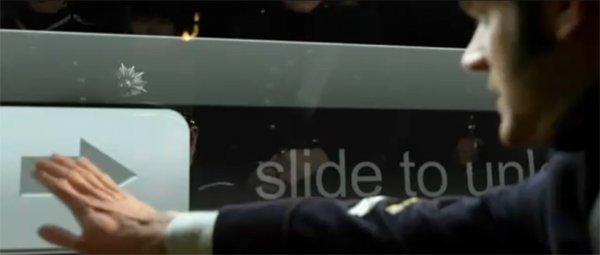
    The upcoming Jack Black comedy, Gulliver’s Travels, which opens Christmas Day, will be one giant Apple ad.

    When Gulliver travels to Lilliput, he brings his iPhone, which when used by the Lilliputians appears gigantic.

    The movie has multiple MacBooks and other Apple products, and Apple logos galore.

    Apple is easily the most successful company ever in getting its products into movies and TV shows. Some 41% of the movies that hit number-one at the box office featured Apple products.

    Part of the reason for this success is that Hollywood is Apple-obsessed. Another is that Apple works at it. The company proudly boasts that it never pays for product placement. But it’s likely that there is some string pulling, proactive offers of devices to use and other actions that are kept secret by the company.

    Whatever Apple is doing, it’s working.

    [via: cultofmac]

  • Dan Brown writing the script for the upcoming THE LOST SYMBOL Movie


    The Lost Symbol

    Mega-selling mystery author Dan Brown has taken over writing duties on the film adaptation of The Lost Symbol.

    Columbia Pictures is developing the film version of Brown’s most recent novel, which was published in 2009 and sold more than a million copies in its first day on shelves. In it, Brown’s regular protagonist, Harvard symbologist Robert Langdon, gets mixed up with the Freemasons in Washington, D.C.

    The 2006 adaptation of The Da Vinci Code and the 2009 version of Angels & Demons grossed $1.24 billion at the worldwide box office for Sony. But this is the first time Brown has taken on screenwriting duties. Akiva Goldsman penned Da Vinci and co-wrote Demons with David Koepp.

    Oscar-nominated Eastern Promises scribe Steven Knight first took a run at the Symbol screenplay. Although Ron Howard and Brian Grazer’s Imagine Entertainment is once again producing, Howard, who directed the first two Brown adaptations, has not committed to directing Symbol. Nor has star Tom Hanks officially come on board to reprise Langdon.

    Regardless, given the sure-thing built-in audience, Sony is sure to have Symbol in theaters sooner rather than later. With Men in Black III and the Spider-Man reboot already set for summer 2012, here’s betting that Brown’s latest is on screens the following summer.

    [via: THR]

  • Loads of News from The Hobbit!


    Now that the seemingly endless saga of The Hobbit’s pre-production woes has finally resolved itself, we can get on with bringing you actual production news, which is a decidedly varied bag today.

    Firstly, we have the not wholly surprising news that (although not definitively confirmed) Ian McKellen seems set to return as Gandalf. His website (www.mckellen.com) details the following in the “2010′s” section:-

    THE HOBBIT’s, two films, start shooting in New Zealand in February 2011. Filming will take over a year. Casting in Los Angeles, New York City and London has started. The script too proceeds. The first draft is crammed with old and new friends, again on a quest in Middle Earth.

    If it’s on his website and in his plans, it should be safe to assume that he will commit to the films before too long. As soon as there is clear confirmation from McKellen or Jackson.

    Next up, Total Film have got on-set snaps of the building work on The Shire, which is taking shape nicely and looking much like we’d expect it to:

    The Shire

    Finally and more positively, Coming Soon report that Jackson has been singing the praises of the 3D rig he is planning to work with on the two prequels. RED Studios Hollywood have announced that the production will be using their (soon to be released) EPIC Digital Cameras. RED said:-

    The successor to RED’s industry changing RED ONE, the EPIC has 5K resolution, can shoot up to 120 frames per second and has a new HDRx™ mode for the highest dynamic range of any digital cinema camera ever made. Taking everything they had learned from building their first camera, RED designed the EPIC from scratch and have produced a smaller, lighter camera that is an order of magnitude more powerful.

    The Hobbit will be amongst the first productions in the world to use the EPIC and at least thirty cameras will be required by the 3-D production. The EPIC’S small size and relatively low weight, makes it perfect for 3-D – where two cameras have to be mounted on each 3D rig.

    Peter Jackson went on to gush effusively as follows:-

    “I have always liked the look of Red footage. I’m not a scientist or mathematician, but the image Red produces has a much more filmic feel than most of the other digital formats. I find the picture quality appealing and attractive, and with the Epic, Jim and his team have gone even further. It is a fantastic tool, the Epic not only has cutting edge technology, incredible resolution and visual quality, but it is also a very practical tool for film makers. Many competing digital systems require the cameras to be tethered to large cumbersome VTR machines. The Epic gives us back the ability to be totally cable free, even when working in stereo.”

    Wow. So he likes it then. A lot. Frankly, anything that helps these films look every bit as spectacular as they should is a great idea and it is surely beyond question that Jackson knows the best way to get the richest version of his vision up on the screen