• Nokia Uses Apple’s Macs to Announce Microsoft Partnership


    As Noted by the folks at Appleinsider Nokia used Apple’s mac to announce their precious partnership with Microsoft, here is the details:

    When Nokia wanted to convince the world that it would bring consumers “stellar hardware and innovative software and great services” in its partnership with Microsoft, it turned to Apple’s Mac-only iMovie to get word out.

    Following the announcement of Microsoft Nokia partnership a video posted by the company’s NokiaConversations YouTube account presents its new chief executive Steven Elop, formerly the head of Microsoft’s Office-centric Business Division, speaking about how Nokia’s new partnership with Microsoft will “create opportunities beyond anything that currently exists.”

    Verizon has already brought Bing to some of its customers forcibly, erasing Google as the default option and generating a response that indicates that, perhaps, consumers don’t really want the brand that much after all. Microsoft also failed to bring Office to mobile phones as promised in its previous partnership with Nokia in 2009, when it was Elop himself representing Microsoft in the photos of executives of the two companies shaking hands.

    Nokia talks Microsoft but uses iMovie

    But that’s not the only thing familiar about Nokia’s video. Adrian Boioglu, a Romanian blogger, noticed that Nokia’s soundtrack was the same used by Apple in its presentation of the new unibody MacBook Pros in 2009. But they’re not just borrowing the same catchy tune.

    The song is actually Pendulum, an Apple Loop installed as part of iMovie, available for royalty free use by anyone who uses a Mac to create iMovies, at least for non-commercial use.

    The license agreement for Apple’s included “loop content’ reads, “You may use the Apple and third party audio loop content (”Audio Content”), contained in or otherwise included with the Apple Software, on a royalty-free basis, to create your own original soundtracks for your video and audio projects. You may broadcast and/or distribute your own soundtracks that were created using the Audio Content, however, individual audio loops may not be commercially or otherwise distributed on a standalone basis, nor may they be repackaged in whole or in part as audio samples, sound effects or music beds.”

    Oops! This isn’t the first time Microsoft has been embarrassed by the use of Macs within its efforts to sell Windows. In 2008, the company’s “I’m a PC” campaign graphics were found to have actually been made on a Mac.
  • Nokia ends up in Microsoft’s arms


    Everyone saw this coming but dang, it doesn’t seem like a great mashup. For instance, are HTC and Samsung going to be stoked that their Windows 7 phone OS is pretty much coming from Nokia, one of their rivals?  Nokia sounds like they will get the Windows Phone 7 good stuff first, it isn’t just hardware.

    And Microsoft.  They are giving up Bing Mobile maps for Nokia’s?  Again, where does that leave Microsoft’s other partners?

    Sounds like a bad plan made out of desperation on both sides.

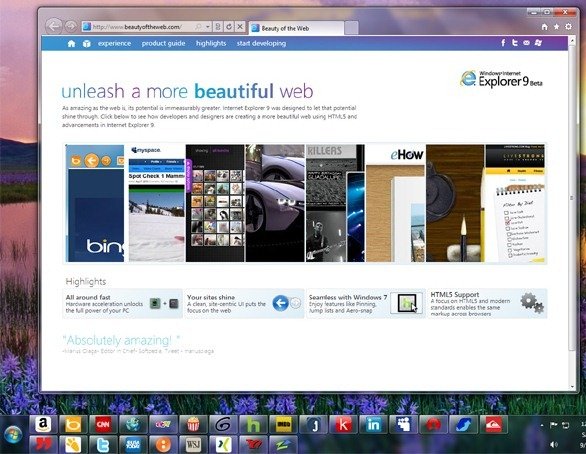
  • Internet Explorer 9 RC Available Now


    Microsoft has just release download links for Release Candidate version of Internet Explorer 9. This new version of IE 9, according to Neowin includes:

    Much improved tab functionality, from the new square-ish visual elements, and moveable tab bar elements to increase customization. It also includes features that enable a user to refuse tracking from advertisers.

    Internet Explorer 9 generally introduces tons of new features, including the new option to pin web apps on Windows 7 taskbar, full support for HTML5 standard, graphics rendering on the GPU level via Microsoft DirectX technology, completely revamped UI and more.

    Download links for Internet Explorer 9 RC:

  • Bing: “We Do Not Copy Results. Period.”


    The war of words between Google and Bing has escalated today with a strong denial about copied search results from Bing’s Yusuf Mehdi, who also accused Google of a form of click fraud in setting up its test involving “honeypot” search results.

    Mehdi, Microsoft’s Senior VP of Online Services, just published a strongly-worded denial of Google’s claims on the Bing Search blog:

    We do not copy results from any of our competitors. Period. Full stop. We have some of the best minds in the world at work on search quality and relevance, and for a competitor to accuse any one of these people of such activity is just insulting.

    That’s in response to yesterday’s developments in which Google accused Bing of copying its search results after running tests that involved the manual promotion of random web pages to rank for nonsense terms on Google.com. A small percentage of the test queries — 7 to 9 of about 100 tested — later produced the same page to rank on Bing.com.

    That led Bing to accuse Google of trying a ‘spy-novelesque stunt’, and Google followed up by calling Bing’s search results a ‘cheap imitation’ of Google.

    Mehdi’s post today turns the heat up more with accusations that Google’s test was a form of click fraud:

    Google engaged in a “honeypot” attack to trick Bing. In simple terms, Google’s “experiment” was rigged to manipulate Bing search results through a type of attack also known as “click fraud.” That’s right, the same type of attack employed by spammers on the web to trick consumers and produce bogus search results. What does all this cloak and dagger click fraud prove? Nothing anyone in the industry doesn’t already know. As we have said before and again in this post, we use click stream optionally provided by consumers in an anonymous fashion as one of 1,000 signals to try and determine whether a site might make sense to be in our index.

    Mehdi points out that Bing first admitted its use of click activity back in the summer of 2009 in a Directions on Microsoft report (membership required, link via SAI). He also points out that Google has been accused of copying Bing several times in the past. (He’s referring to Google image search, home page photos, and even Google’s adoption of a 3-column interface last year, which Ask.com had before both Bing and Google.)

    It’s anyone’s guess how long this war of words will go on, as both sides seem to want to have the last word. That status belongs to Bing now, but for how long?

    [source & more info at searchengineland]