• The View Inside Google Self-Driving Car’s Cockpit


    Some lucky attendees of this week’s TED conference were given rides in Google’s self-driving car. And one in particular was kind enough to take a video of what it’s like to ride shotgun. Plenty of NSFW language, because THE CAR IS DRIVING ITSELF

    Google’s been working on these self driving cars in secret but are actually testing them right now, right out in the open. The NY Times saw one of these cars in action:

    A Prius equipped with a variety of sensors and following a route programmed into the GPS navigation system nimbly accelerated in the entrance lane and merged into fast-moving traffic on Highway 101, the freeway through Silicon Valley.

    It drove at the speed limit, which it knew because the limit for every road is included in its database, and left the freeway several exits later. The device atop the car produced a detailed map of the environment.

    The car then drove in city traffic through Mountain View, stopping for lights and stop signs, as well as making announcements like “approaching a crosswalk” (to warn the human at the wheel) or “turn ahead” in a pleasant female voice.

    Ideally, there’s a driver sitting at the steering wheel, ready to take over whenever anything

    [via: YouTube via GIZMODO]

  • Steve Jobs to meet with President Obama Tomorrow


    Apple CEO Steve Jobs will reportedly join Google chief executive Eric Schmidt and Facebook founder Mark Zuckerberg in a meeting with US President Barack Obama in San Francisco on Thursday.

    Though recent reports have alleged that Jobs’ health has continued to decline, the executive is scheduled to attend a business leaders’ event with President Obama Thursday evening, a source told ABC News.

    Google’s Schmidt, who will step down as CEO in April; GE CEO Jeffrey Immelt, the newly named chairman of the White House Council on Jobs and Competitiveness, and Facebook’s Zuckerberg will also be in attendance, according to sources familiar with the meeting.

  • Google Capitalizes Backlash Over Apple’s App Store In-App Subscription


    Google on Wednesday announced a new Web subscription service for publishers called “One Pass,” in which the search giant will keep just 10 percent of revenues in transactions, compared to Apple’s 30 percent cut of iOS content. Good timing/well played by Google. Check out what Appleinsider had to say about the matter:

    Google One Pass allows subscribers to access content they’ve paid for on a variety of devices using a single username and login on a website. It also offers business model flexibility, allowing content providers to offer subscriptions, day passes, metered access, pay-per-article, or multi-issue packages to customers.

    “By providing a system for user authentication, payment processing, and administration, Google One Pass lets publishers focus on creating high quality content for their readers,” the company said. “Publishers have flexibility over payment models and control over the digital content for which they charge and the content that is free for consumers.”

    One Pass also allows publishers to grant access to existing subscribers through a coupon-based system. Publishers host their own content, and must add what is referred to as a “small amount of code” to a website. “Development effort is minimal,” Google said.

    The new service was announced just a day after Apple unveiled its own subscription plan for software on the iOS App Store. Apple takes a 30 percent cut of all sales through the App Store, but publishers can offer access to existing subscribers if they provide their own authentication process inside their iOS application.

    According to The Wall Street Journal, Google’s One Pass will undercut Apple, and the search company will only keep a 10 percent cut of sales. But Google will also allow publishers control of subscribers’ personal data, something Apple has been reluctant to do.

  • Google Translate for iOS released


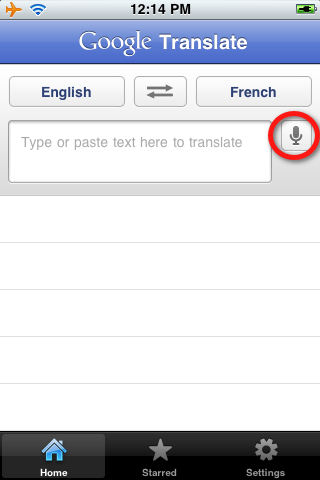
    Google just released their native translation app for iOS (iTunes download) which allows you to speak translations and hear results.

    OK, this is friggen awesome!  details, below:

    Speak to translate
    The new app accepts voice input for 15 languages, and—just like the web app—you can translate a word or phrase into one of more than 50 languages. For voice input, just press the microphone icon next to the text box and say what you want to translate.

    Listen to your translations
    You can also listen to your translations spoken out loud in one of 23 different languages. This feature uses the same new speech synthesizer voices as the desktop version of Google Translate we introduced last month.

    Full-screen mode
    Another feature that might come in handy is the ability to easily enlarge the translated text to full-screen size. This way, it’s much easier to read the text on the screen, or show the translation to the person you are communicating with. Just tap on the zoom icon to quickly zoom in.

    And the app also includes all of the major features of the web app, including the ability to view dictionary results for single words, access your starred translations and translation history even when offline, and support romanized text like Pinyin and Romaji.

    Get it here.